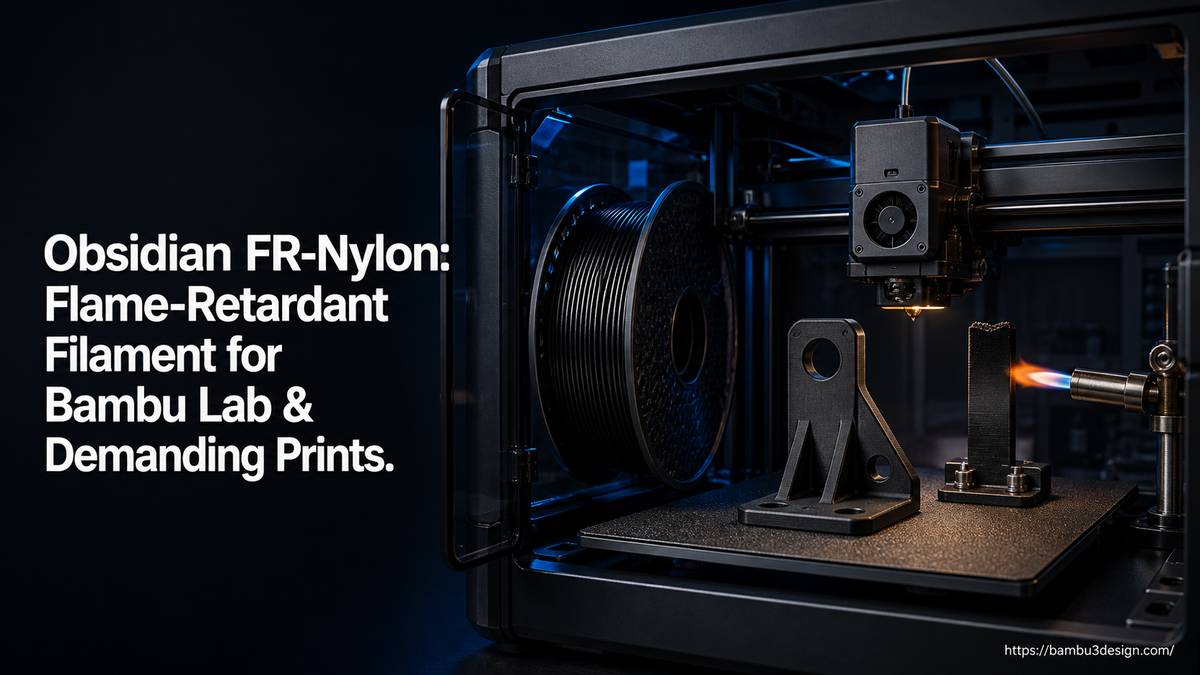
Obsidian FR-Nylon: A Flame-Retardant, Bambu Lab Friendly Filament for Demanding Applications
When 3D printing components for demanding environments, material properties like strength, durability, and heat resistance are crucial. However, for applications where fire safety is paramount, standard engineering filaments may not suffice. Nylon, a popular choice for its mechanical properties, can pose significant safety concerns during combustion, producing dense smoke, ash, and harmful fumes.
This is where specialized flame-retardant materials like 3DXTech Obsidian FR-Nylon step in. Developed as a high-performance, cost-effective alternative to Markforged Onyx FR, Obsidian FR-Nylon offers a critical safety feature: a UL94 V-0 flame retardancy rating at 3.0 mm. Notably, it’s also designed to be compatible with a broader range of FDM printers, including Bambu Lab machines, making advanced safety-critical printing more accessible.
What is 3DXTech Obsidian FR-Nylon?
Obsidian FR-Nylon is a flame-retardant, carbon fiber reinforced nylon filament. It builds upon the established performance of 3DXTech’s original carbon fiber reinforced Obsidian nylon, integrating advanced flame retardant properties. This combination results in a filament that offers exceptional mechanical strength and durability, coupled with enhanced fire safety.
Key Characteristics:
- Flame Retardancy: The most significant feature is its UL94 V-0 rating at 3.0 mm. This indicates that the material self-extinguishes within 10 seconds on a vertical part, with no flaming drips, making it suitable for applications where fire safety is a primary concern.
- Carbon Fiber Reinforcement: The inclusion of carbon fiber significantly enhances the filament’s stiffness, strength, and dimensional stability, similar to other high-performance carbon fiber nylons.
- Nylon Base: Retains the inherent toughness, wear resistance, and chemical resistance associated with nylon materials.
Standard nylon’s combustion characteristics, often comparable to more flammable materials like PETG, limit its use in safety-critical parts. Obsidian FR-Nylon addresses this by providing a material that reduces fire risks and helps meet compliance standards across various industries.
Obsidian FR-Nylon vs. Markforged Onyx FR: A Cost-Effective Rival
One of the primary motivations behind the development of Obsidian FR-Nylon was to offer a more accessible and versatile alternative to Markforged Onyx FR. Historically, high-performance, flame-retardant carbon fiber nylons were often tied to proprietary ecosystems, limiting their adoption.
Key Comparisons:
- Cost Efficiency: Obsidian FR-Nylon is positioned as a significantly more affordable option, with reported savings of over 30% compared to Markforged Onyx FR. Some sources suggest it can be up to 34% cheaper, making advanced materials more economically viable for a wider range of users.
- Ecosystem Agnostic: Unlike Onyx FR, which is primarily designed for the Markforged ecosystem, Obsidian FR-Nylon is built for use beyond specific printer platforms. This wider compatibility opens up advanced material capabilities to a broader market.
- Performance: 3DXTech developed Obsidian FR-Nylon to rival Onyx FR in performance, offering comparable mechanical properties and flame retardancy for demanding applications. Its UL94 V-0 rating confirms its suitability for safety-critical components.
- Testing: 3DXTech has reportedly tested Obsidian FR-Nylon on Bambu Lab printers, specifically mentioning a “Bambu Lab H2D printer,” demonstrating its compatibility and reliable performance on these popular FDM machines.
This makes Obsidian FR-Nylon an attractive choice for users seeking high-performance, flame-retardant parts without the premium cost or vendor lock-in often associated with specialized industrial filaments.
Why Choose Obsidian FR-Nylon for Your Bambu Lab Printer?
The “Bambu Lab friendly” nature of Obsidian FR-Nylon is a significant advantage for owners of Bambu Lab X1-Carbon, P1S, or similar printers. These machines are known for their speed, precision, and ability to handle engineering-grade filaments, making them ideal candidates for advanced materials like carbon fiber reinforced nylons.
- Enhanced Material Options: Bambu Lab users gain access to a flame-retardant filament that meets stringent safety standards, expanding the range of functional parts they can produce.
- Cost Savings: Printing safety-critical components becomes more economical, allowing for greater experimentation and production of high-value parts without incurring prohibitive material costs.
- Versatility: The ability to print such advanced materials on a desktop-style FDM printer like a Bambu Lab machine democratizes access to applications traditionally reserved for industrial systems.
While specific print settings for Obsidian FR-Nylon on Bambu Lab printers will vary based on the specific model and desired print quality, the filament’s design for broader compatibility suggests a smoother integration than highly proprietary alternatives.
Applications for Flame-Retardant Nylon Filaments
The flame-retardant properties of Obsidian FR-Nylon make it indispensable for applications where fire safety is a critical design requirement. This filament is engineered for environments where standard plastics would pose a risk due to their flammability and smoke generation characteristics.
Common applications include:
- Aerospace Components: Interior parts, housings, and structural elements that require flame retardancy to meet aviation safety standards.
- Automotive Parts: Under-the-hood components, interior trim, and electronic enclosures where fire resistance is vital.
- Electronics Enclosures: Casings for sensitive electronic devices, circuit boards, and connectors that need to prevent fire propagation.
- Industrial Equipment: Machine parts, protective covers, and tooling in manufacturing environments where sparks or high temperatures could be present.
- Consumer Goods: Appliances and products that require enhanced safety features to comply with regulatory standards.
Tips for Printing with Carbon Fiber Nylon Filaments
When working with carbon fiber reinforced nylon filaments like Obsidian FR-Nylon, proper preparation and slicer settings are key to achieving successful prints.
- Use a Hardened Nozzle: Carbon fiber is abrasive and will quickly wear down standard brass nozzles. A hardened steel or ruby-tipped nozzle is essential to prevent premature nozzle wear and maintain print quality.
- Dry Your Filament: Nylon is highly hygroscopic, meaning it readily absorbs moisture from the air. Moist filament will lead to poor print quality, stringing, bubbles, and reduced mechanical properties. Always print from a dry box and dry the filament thoroughly before use, typically at 60-80°C for several hours.
- High Print Temperatures: Nylon and carbon fiber nylon typically require higher extrusion temperatures than common filaments like PLA or PETG. Consult the manufacturer’s recommended temperature range (e.g., 250-280°C) and conduct temperature towers to find the optimal setting for your specific printer.
- Heated Bed and Adhesion: A heated bed is crucial for good bed adhesion and to prevent warping. A bed temperature of 80-100°C is common. Use an appropriate adhesive such as a thin layer of PVA glue, a specific nylon adhesive, or a PEI sheet designed for engineering filaments.
- Enclosure Recommended: An enclosed print chamber helps maintain a stable ambient temperature around the print, reducing thermal stress and minimizing warping, especially for larger parts. Bambu Lab printers with enclosures (like the X1-Carbon and P1S with enclosure) are well-suited for this.
- Slow Print Speeds: While Bambu Lab printers are fast, printing carbon fiber nylon at slightly slower speeds can improve layer adhesion and surface quality, especially for critical functional parts.
- Slicer Settings: Adjust retraction settings to minimize stringing, ensure adequate cooling (though often less is needed for nylon), and consider slightly wider extrusion widths for improved layer bonding.
Conclusion
3DXTech Obsidian FR-Nylon represents a significant advancement for those requiring flame-retardant, high-performance parts through FDM 3D printing. By offering a UL94 V-0 rated carbon fiber nylon that is both cost-effective and compatible with a wider range of desktop printers, including Bambu Lab machines, it makes advanced manufacturing capabilities more accessible.
Whether you’re designing components for aerospace, automotive, electronics, or industrial use, Obsidian FR-Nylon provides a robust solution that combines mechanical strength with critical fire safety. Its availability opens new possibilities for engineers and makers to produce safer, more durable, and compliant 3D printed parts.