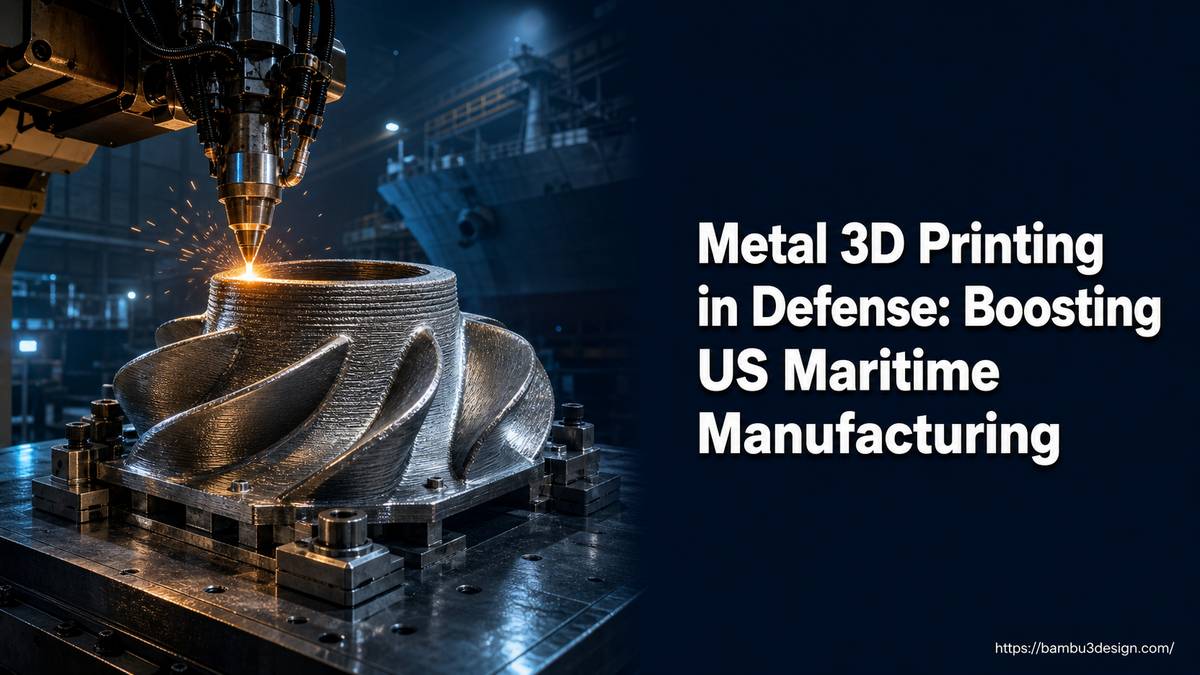
Metal 3D Printing in Defense: Boosting US Maritime Manufacturing
The landscape of defense manufacturing is undergoing a significant transformation, driven by the strategic integration of advanced additive manufacturing (AM) technologies. Traditional manufacturing methods often face challenges such as long lead times, complex supply chains, and the high cost of producing specialized components. These issues are particularly acute in critical sectors like the maritime and submarine industrial base, where component shortages can impact national security.
To address these bottlenecks, the U.S. government is increasingly investing in metal 3D printing solutions. A prime example is the recent $4.2 million contract awarded to Norsk Titanium, demonstrating a clear bet on additive manufacturing’s ability to provide efficient, reliable, and high-performance parts for mission-critical applications.
The Strategic Imperative for Additive Manufacturing in Defense
Government and defense organizations are rapidly moving beyond pilot projects, adopting 3D printing for practical, everyday use. The shift is driven by a need to:
- Shorten Lead Times: Rapid prototyping and on-demand production can significantly reduce the time it takes to acquire crucial parts.
- Reduce Supply Chain Risk: Localized manufacturing capabilities mitigate dependencies on global supply chains, enhancing resilience and security.
- Improve Operational Efficiency: Producing spare parts, tools, and lightweight components directly where they are needed streamlines logistics and maintenance.
Additive manufacturing’s flexibility allows defense agencies to react quickly to changing operational signals, ensuring readiness and adaptability in an unpredictable environment. The technology is being explored for large structural components, engine parts, and even expeditionary manufacturing aboard naval vessels.
Norsk Titanium’s Rapid Plasma Deposition (RPD) Technology
At the forefront of this industrial shift is Norsk Titanium, a global leader in metal 3D printing specializing in structural titanium additive manufacturing. The company’s proprietary technology, Rapid Plasma Deposition (RPD), is a wire-fed titanium process that offers distinct advantages over conventional manufacturing methods:
- Material Efficiency: RPD significantly reduces raw material waste, contributing to cost savings and a smaller environmental footprint.
- Energy and Time Savings: The process requires substantially less energy and time compared to traditional forming methods, accelerating production schedules.
- High-Performance Components: RPD is capable of producing certified, high-performance titanium components for demanding applications in aerospace, defense, and other industrial sectors.
- Expandable Capabilities: Norsk Titanium is also extending RPD’s capabilities to include nickel-based alloys, further broadening its application in critical defense supply chains.
This technology enables the cost-efficient, lower-emission production of high-value metal components, making it an attractive solution for complex defense requirements.
Impact on the Maritime and Submarine Industrial Base
The $4.2 million contract from the Office of the Assistant Secretary of War for Industrial Base Policy is a significant validation of Norsk Titanium’s role in strengthening U.S. defense capabilities. The 18-month award is specifically earmarked to support the development of RPD technology to bolster the next-generation manufacturing for the U.S. maritime and submarine industrial base.
The U.S. Navy faces an ongoing challenge with submarine part shortages, which can delay maintenance and impact operational readiness. By investing in Norsk Titanium’s advanced metal 3D printing, the U.S. aims to directly address these issues by enabling the rapid, on-demand production of critical titanium components.
This initiative will:
- Accelerate Part Production: Faster manufacturing of complex titanium parts, reducing lead times for submarine components.
- Enhance Supply Chain Resilience: Create a more robust and responsive domestic supply chain for essential maritime components.
- Improve Fleet Readiness: Ensure that submarines and other naval assets have timely access to necessary parts, minimizing downtime.
Broader Applications in Government and Defense
Beyond submarine components, additive manufacturing is finding diverse applications across the government and defense sectors:
- Aircraft Components: GKN Aerospace and Pratt & Whitney are collaborating on laser-directed energy deposition with wire additive manufacturing for large structural components of the F135 engine.
- Large-Format Production: Companies like Beehive Industries are expanding their capacity with systems for large-format metal AM, indicating a trend toward producing bigger, more complex parts.
- Expeditionary Manufacturing: Phillips Federal is deploying containerized hybrid manufacturing systems, integrating CNC platforms with wire-laser metal AM technology, aboard naval ships like the USS Essex. This evaluates the feasibility of producing parts at sea, improving readiness in remote or deployed environments.
- Reinforcement: Continuous Fiber Injection Process (CFIP) technology is being developed to facilitate structural reinforcement in AM workflows, enhancing the durability of printed parts.
These diverse applications highlight additive manufacturing’s versatility and its growing importance in addressing various defense challenges, from supply chain vulnerabilities to the need for advanced, lightweight materials.
Advantages of Metal Additive Manufacturing for Defense
The adoption of metal 3D printing in defense offers several compelling advantages:
- Customization and Complexity: Enables the production of highly complex geometries and customized parts that are difficult or impossible to create with traditional methods, leading to optimized designs and improved performance.
- Weight Reduction: The ability to design and print optimized, lightweight components is crucial for aerospace and maritime applications, improving fuel efficiency and operational range.
- On-Demand Production: Facilitates the production of spare parts on demand, reducing the need for large inventories and enabling quick repairs.
- Material Variety: While titanium and nickel-based alloys are prominent, the technology continues to expand to other high-performance metals.
- Reduced Waste: Processes like RPD minimize material waste, which is not only environmentally friendly but also cost-effective, especially with expensive materials like titanium.
Conclusion
The U.S. government’s investment in Norsk Titanium’s Rapid Plasma Deposition technology underscores the critical role metal 3D printing is playing in modernizing defense manufacturing. By leveraging additive manufacturing, the defense industry can overcome traditional supply chain limitations, accelerate the production of mission-critical components, and enhance overall operational readiness.
From submarine parts to aircraft engines and on-site expeditionary manufacturing, metal 3D printing is proving to be an indispensable tool for national security. As the technology continues to evolve, its impact on efficiency, cost-effectiveness, and strategic independence within the defense sector will only grow, solidifying its position as a cornerstone of next-generation industrial production.