Can a Cleaner PLA Filament Also Deliver Better Print Quality?
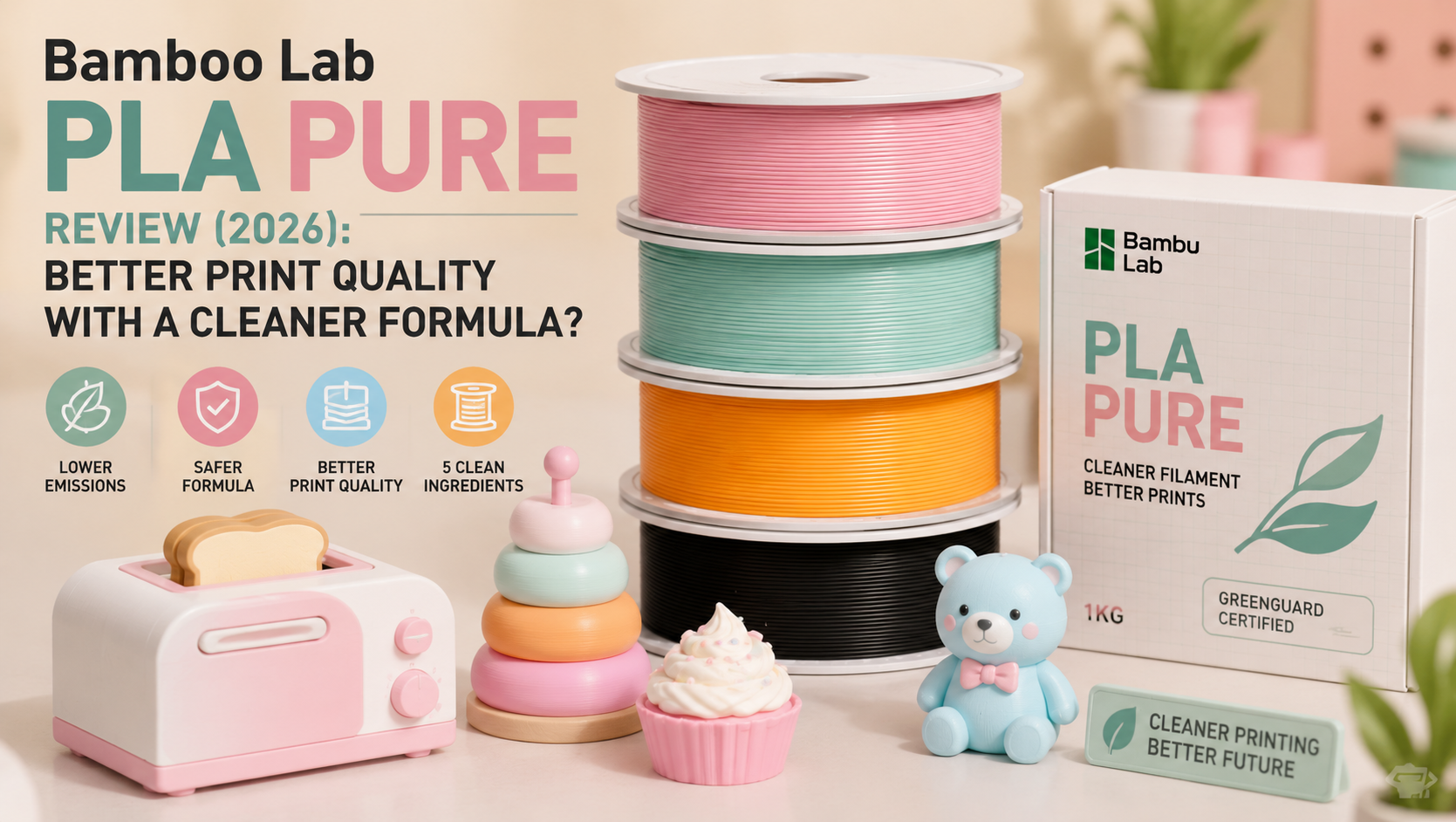
Bambu Lab has officially introduced PLA Pure, a brand-new PLA filament designed with a simplified five-ingredient formula that aims to reduce harmful emissions while maintaining excellent print quality. Unlike many conventional PLA filaments, which often contain undisclosed additives, PLA Pure focuses on transparency, cleaner materials, and reliable printing performance.
But is this simply another PLA filament with clever marketing, or does it actually offer meaningful improvements?
In this review, we’ll examine everything you need to know about Bambu Lab PLA Pure, including its material composition, certifications, print quality, safety claims, advantages, limitations, and whether it’s worth buying.
What Is Bambu Lab PLA Pure?
PLA Pure is Bambu Lab’s latest standard PLA filament developed for makers who want cleaner indoor printing without sacrificing print quality.
According to Bambu Lab, the new material was created from scratch rather than simply modifying its existing PLA Basic formulation. The company removed many of the unnecessary additives commonly found in consumer PLA while maintaining excellent mechanical properties.
Currently, PLA Pure is available in several colors with a retail price of approximately $24.99 per kilogram.
Why Did Bambu Lab Develop PLA Pure?
Many PLA filaments contain additional chemicals such as stabilizers, processing aids, pigments, plasticizers, and other proprietary additives.
Although these ingredients often improve printability, they may also increase emissions during printing.
Bambu Lab’s goal with PLA Pure was simple:
- Reduce unnecessary chemical additives
- Lower airborne emissions during printing
- Improve material transparency
- Maintain the same reliable print quality users expect
The company describes PLA Pure as its cleanest PLA formulation to date.
What’s Inside PLA Pure?
One of the most interesting aspects of PLA Pure is that Bambu Lab openly discloses its primary ingredients.
The filament contains only five major components:
- PLA resin
- Acrylic copolymer
- Food-contact compliant pigments
- Ethylene Bis-Stearamide (EBS)
- Asbestos-free talcum powder
Most filament manufacturers never reveal their exact formulation, making this level of transparency quite unusual.
The raw materials are supplied by internationally recognized chemical companies including Dow and BASF.
Lower Emissions During Printing
One of the biggest selling points of PLA Pure is its reduced emissions.
Bambu Lab tested the material using the UL 2904 standard, which evaluates particle and chemical emissions generated during desktop 3D printing.
Based on these tests, PLA Pure earned UL GREENGUARD Certification, meaning its emissions remain below established indoor air quality limits during printing.
This certification places PLA Pure alongside only a small number of consumer filaments currently available on the market.
However, it’s important to understand that low emissions do not mean zero emissions.
Bambu Lab still recommends printing in a well-ventilated environment.
Is PLA Pure Food Safe?
This is where many users become confused.
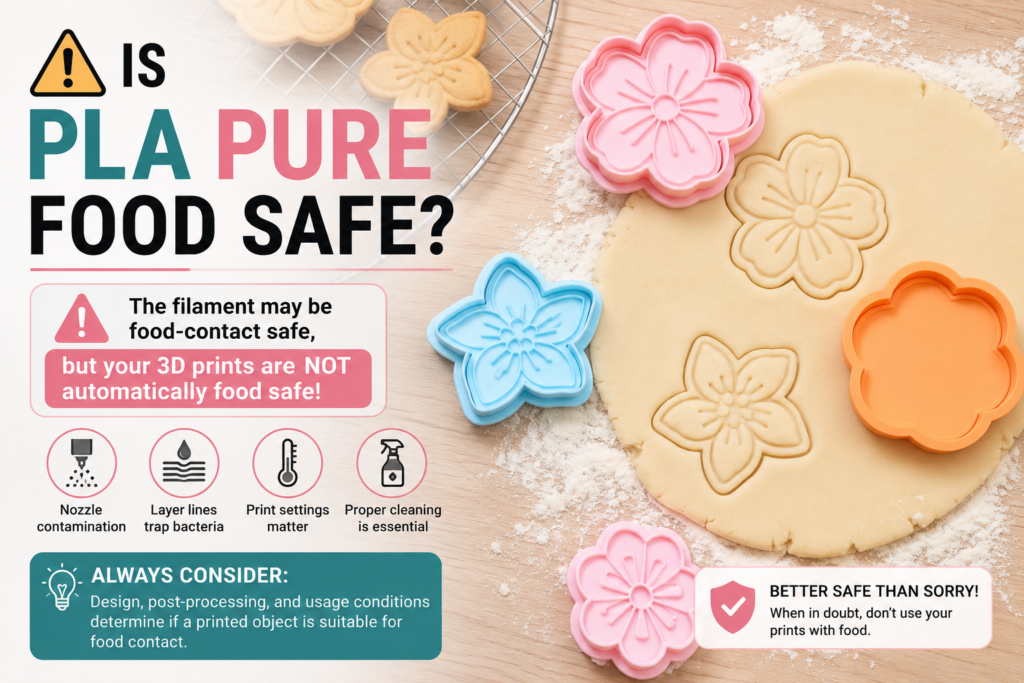
Every ingredient used to manufacture PLA Pure complies with EU Regulation No.10/2011 for food-contact materials.
However, this certification applies only to the filament itself—not the printed object.
After printing, several factors affect food safety:
- Nozzle contamination
- Printer cleanliness
- Layer lines and bacteria growth
- Printing temperature
- Post-processing
For this reason, Bambu Lab clearly states that printed parts should not automatically be considered food-safe, even when produced using PLA Pure.
Toy Safety
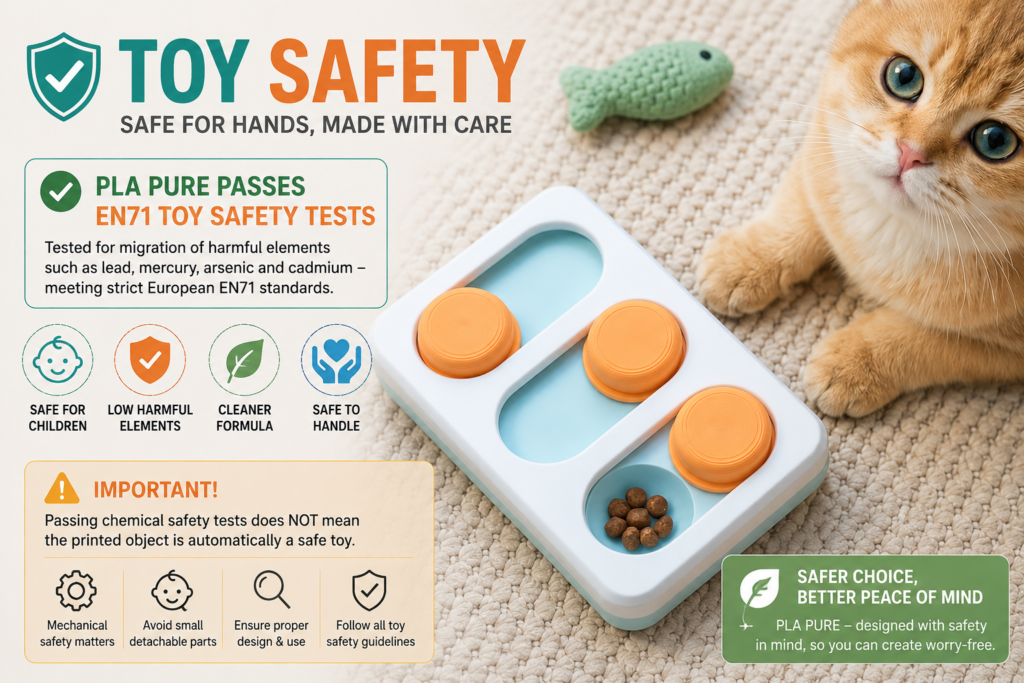
PLA Pure also passed migration testing under the European EN71 Toy Safety Standard.
This means the material releases extremely low levels of regulated elements such as:
- Lead
- Mercury
- Cadmium
- Arsenic
While this is encouraging for decorative toys and handled objects, it does not certify the final printed model as a toy.
Mechanical safety, durability, sharp edges, and choking hazards are not covered by this certification.
Print Quality
Print quality is where PLA Pure becomes particularly interesting.
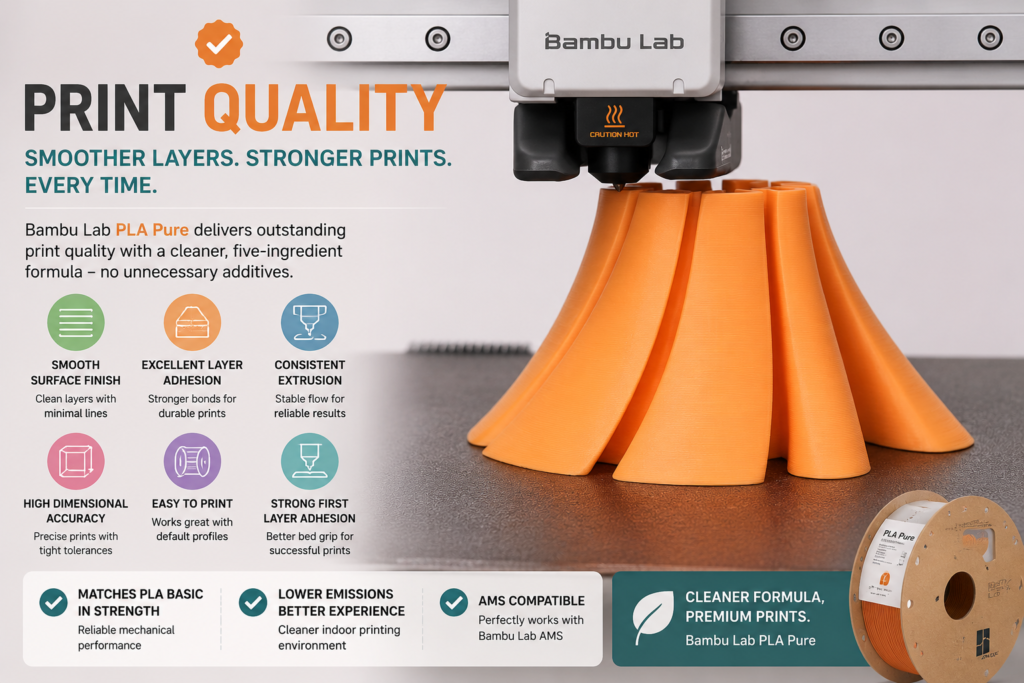
Despite using fewer additives, Bambu Lab states that PLA Pure performs almost identically to PLA Basic.
According to the company’s testing, users can expect:
- Excellent layer adhesion
- Smooth surface finish
- Consistent extrusion
- High dimensional accuracy
- Reliable first-layer adhesion
- Mechanical properties comparable to PLA Basic
The filament is also fully compatible with Bambu Lab AMS systems.
For most users, switching from PLA Basic to PLA Pure should require little or no adjustment to existing print profiles.
Advantages
✅ Cleaner five-ingredient formulation
✅ Lower printing emissions
✅ UL GREENGUARD Certified
✅ Excellent print quality
✅ Strong layer adhesion
✅ Transparent material composition
✅ Compatible with AMS
✅ Suitable for everyday printing
Limitations
Although PLA Pure offers several improvements, it still shares the same limitations as traditional PLA.
It begins softening at approximately 60°C, making it unsuitable for:
- Dishwasher use
- Hot car interiors
- Outdoor summer exposure
- High-temperature functional parts
Proper ventilation is still recommended during printing.
Is PLA Pure Worth Buying?
If you regularly print indoors and value both print quality and cleaner materials, PLA Pure is one of the most interesting new PLA filaments released this year.
Its reduced additive formulation, independent certifications, and excellent printing performance make it an attractive upgrade over many generic PLA products.
Although it is not completely emission-free or universally food-safe, PLA Pure represents a positive step toward healthier desktop 3D printing.
Final Verdict
Bambu Lab has taken a different approach with PLA Pure.
Rather than simply marketing another standard PLA, the company focused on reducing unnecessary additives, improving transparency, lowering emissions, and maintaining excellent print quality.
For makers looking for a reliable everyday PLA with cleaner indoor printing characteristics, PLA Pure is certainly worth considering.
Whether it becomes the new benchmark for consumer PLA will depend on long-term user experience, but it is already one of the most promising PLA releases of 2026.