Authenticating 3D Printed Parts: Ensuring Trust and Traceability
As additive manufacturing (AM) expands into critical applications across aerospace, defense, and motorsport, the need for robust verification and traceability of 3D printed parts has become paramount. Unlike traditional manufacturing, the decentralized nature of 3D printing and the complexity of composite materials can introduce challenges in ensuring authenticity, material conformity, and production history throughout the supply chain.
This guide explores the evolving landscape of 3D printed part authentication, focusing on digital identity platforms designed to build trust and prevent counterfeiting in high-stakes industries.
The Growing Need for 3D Printed Part Authentication
The increasing adoption of 3D printing for producing end-use components, especially those in demanding environments, necessitates stringent quality control and verification. Manufacturers and end-users alike need absolute certainty about the origin, specifications, and integrity of each part.
Challenges in Complex Supply Chains
Modern manufacturing supply chains are global and often involve multiple tiers of suppliers. For 3D printed components, this complexity can be exacerbated by:
- Customization: Unique parts with specialized designs and materials make generic tracking difficult.
- Material Variability: The wide range of advanced filaments and resins, each with specific properties, requires precise material verification.
- Intellectual Property Protection: Preventing unauthorized reproduction or use of proprietary designs.
High-Stake Applications Demand Reliability
In sectors where component failure can have catastrophic consequences, such as aerospace and defense, there is no margin for error. Parts must conform exactly to specifications, have verifiable production histories, and maintain their integrity throughout their lifecycle. Ensuring the authenticity of these components is crucial for safety and performance.
Introducing Digital Identity for 3D Prints: CRP UniqTrust
Recognizing these challenges, companies are developing innovative solutions to assign a unique, verifiable digital identity to each 3D printed part. One such system is CRP UniqTrust, developed by the Modena-based CRP Group in collaboration with Contatto Divino (a division of Pengo Idee Onlife). This platform aims to provide tightened traceability and verification for parts made from CRP’s high-performance Windform additive manufacturing composites.
How CRP UniqTrust Works
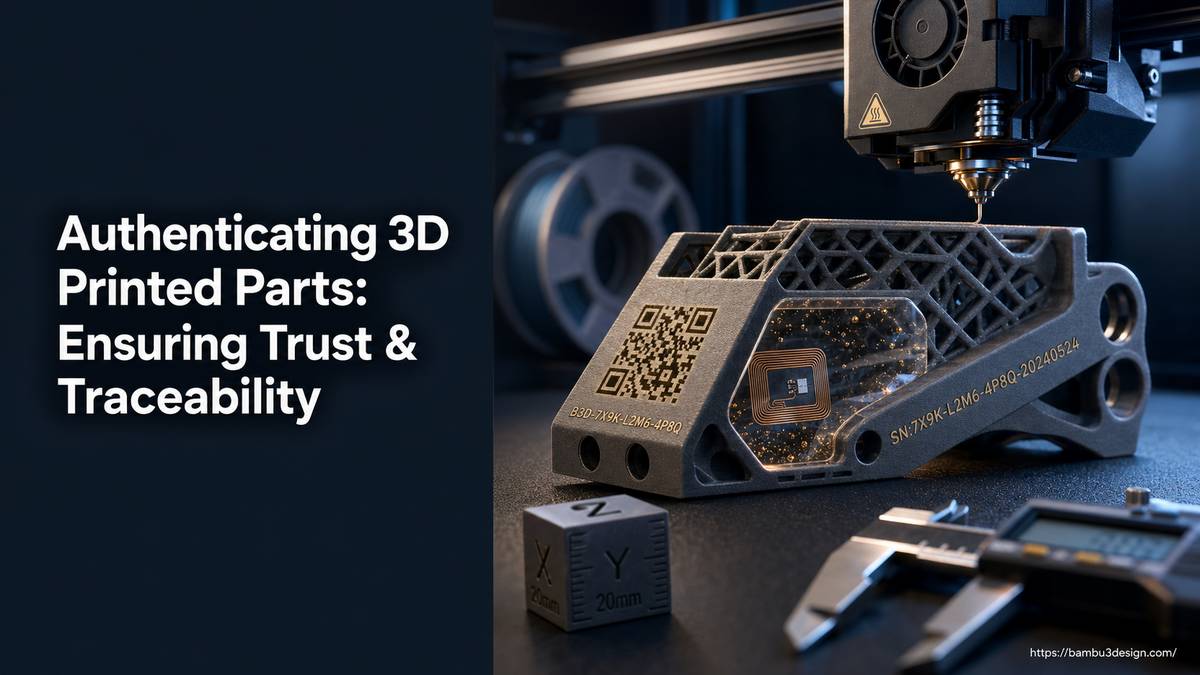
At its core, CRP UniqTrust establishes an unbreakable link between a physical 3D printed part and a secured digital file. The process involves:
- Digital Identity Assignment: Each Windform component produced by CRP Technology (CRP Group’s SLS 3D printing arm) is assigned a unique digital identity during manufacturing.
- Non-Clonable Element: A non-clonable element is embedded within the part’s packaging. This element is intrinsically tied to the component’s digital identity, making it impossible to duplicate.
- Verification Process: An authorized operator can verify the part’s authenticity and access its digital file by simply holding an enabled device near the packaging. Confirmation is near-instantaneous.
Key Information Captured
The associated digital file serves as a comprehensive record for the part. It can securely store vital information, including:
- Certificate of Authenticity: Proof that the part is genuine and manufactured by CRP.
- Order References and Part Code: Unique identifiers for tracking and inventory management.
- Material Used: Specific details about the Windform composite employed (e.g., Windform LX 3.0).
- Production Details: Information on how and when the part was produced.
- Customized Technical Documentation: On request, additional technical specifications or performance data can be linked.
This digital approach eliminates the need for extensive physical paperwork, providing a single, retrievable source of truth for each component.
The Role of Non-Clonable Elements
The non-clonable element is critical to the system’s security. It ensures that the digital identity cannot be separated from the physical part or illicitly transferred to a counterfeit. This fundamental link provides a high level of confidence in the part’s integrity, safeguarding against replication or substitution.
Benefits of Digital Traceability for 3D Printed Parts
The implementation of digital identity platforms offers significant advantages for manufacturers and consumers of 3D printed components.
- Enhanced Supply Chain Integrity: By instantly verifying a part’s identity, the system can flag inconsistencies, such as a read request from an unauthorized or unintended recipient. This safeguards the supply chain against unauthorized diversions or counterfeiting.
- Streamlined Documentation: Digital access to product information reduces reliance on physical certificates and datasheets, minimizing administrative overhead and potential for human error.
- Unwavering Conformity: Parts can prove their identity and conformity at any point in their lifecycle, from manufacturing to deployment and maintenance. This is crucial for components in mission-critical roles.
- Meeting Regulatory Standards: The move towards digital product passports, like those mandated by the European Union, highlights a broader industry shift towards greater traceability and product data. Systems like UniqTrust proactively address these emerging regulatory demands for sustainability and authenticity.
Real-World Impact: Where Authentication Matters Most
CRP Group’s history of working with demanding customers underscores the practical application of such authentication systems. For over 55 years, they have manufactured components for applications where margins of error are unacceptable.
Aerospace and Defense
In aerospace, 3D printed parts are subject to extreme conditions. For instance, CRP USA supplied Windform LX 3.0 composite parts for the Portland State Aerospace Society’s OreSat0 CubeSat. These parts, including a turnstile antenna assembly, a star tracker camera lens, and a battery assembly, successfully met rigorous vibration, outgassing, and thermal performance requirements for low Earth orbit. The ability to authenticate these parts throughout their journey from manufacturing to space ensures operational reliability.
Motorsport
Motorsport demands high-performance, lightweight components, often produced with advanced additive manufacturing techniques. Ensuring the authenticity and material composition of these parts is vital for competitive advantage and safety.
Conclusion
The introduction of digital identity platforms marks a significant step forward in securing the future of additive manufacturing. By enabling verifiable traceability and combating counterfeiting, systems like CRP UniqTrust instill a new level of trust in 3D printed parts, particularly for the most demanding applications. As 3D printing continues to innovate, the ability to confirm a part’s digital identity will be indispensable for maintaining product integrity, streamlining supply chains, and meeting evolving regulatory requirements worldwide.
For industries relying on advanced 3D printed composites, verifying authenticity is no longer a luxury but a fundamental necessity for safety, performance, and long-term reliability. The shift towards digital product passports ensures that this trend will only accelerate, making robust 3D printed part authentication systems increasingly vital across the manufacturing landscape.