3D Printed Homes in Colorado: Building the Future of Housing
The rising cost of housing, coupled with labor shortages and the demand for more efficient construction, presents a significant challenge across many regions. In Colorado, these issues are particularly acute, compounded by environmental concerns like wildfire risk in mountain communities. However, a promising solution is emerging: large-scale 3D printed homes. Pioneering projects in Colorado are demonstrating how additive construction (AC) can transform residential development, offering speed, cost-efficiency, and enhanced resilience.
Addressing the Housing Crisis with Additive Construction
The traditional construction industry faces hurdles that contribute to high housing costs and slow development cycles. Additive construction, commonly known as 3D concrete printing, offers a compelling alternative by automating much of the building process. This innovative approach allows for faster completion times and reduced labor requirements, which can directly translate into more affordable housing options.
Recent federal efforts, such as the “21st Century Road to Housing Act,” are designed to create a national framework that supports new solutions for builders aiming to lower costs. This legislative backing, alongside grant programs for fast-tracked construction projects, provides a fertile ground for the growth of 3D printed housing initiatives. The private sector, particularly in Colorado, has been quick to leverage these opportunities, proving that 3D printing is ready to move beyond demonstration projects and into scalable community development.
Cleora: A Vision for a Comprehensive 3D Printed Community
One of the most ambitious projects showcasing the potential of 3D printed homes Colorado is the planned community of Cleora. Located on 55 acres in central Colorado, near Salida, this development aims to integrate cutting-edge additive construction into a fully functional residential area. The overall community will comprise 106 homes, with approximately two-thirds of these slated for construction using 3D printing technology.
RIC Robotics, an AC service provider headquartered in Denver and a specialist in commercial 3D concrete printing, is a key partner in the Cleora project. Their advanced construction robots are central to achieving the scale and efficiency required for such a large undertaking. The vision extends beyond individual homes; Cleora is planned as its own metro district, incorporating essential infrastructure such as utilities and recreational facilities into its blueprint from day one.
Another significant contributor to 3D printed housing in the Colorado region is VeroTouch, based in Salida. VeroTouch is actively developing its own “Cleora development” featuring 16 3D-printed houses, demonstrating the practical application of this technology. These projects aim not just to build houses, but to create sustainable communities that are built to last.
Beyond direct construction, the Cleora project also focuses on workforce development. Project managers are partnering with Colorado Mountain College, a local community college, to train students for careers in automated construction. This foresight addresses future labor needs while fostering local talent equipped with advanced building skills.
The Technology Behind 3D Printed Homes
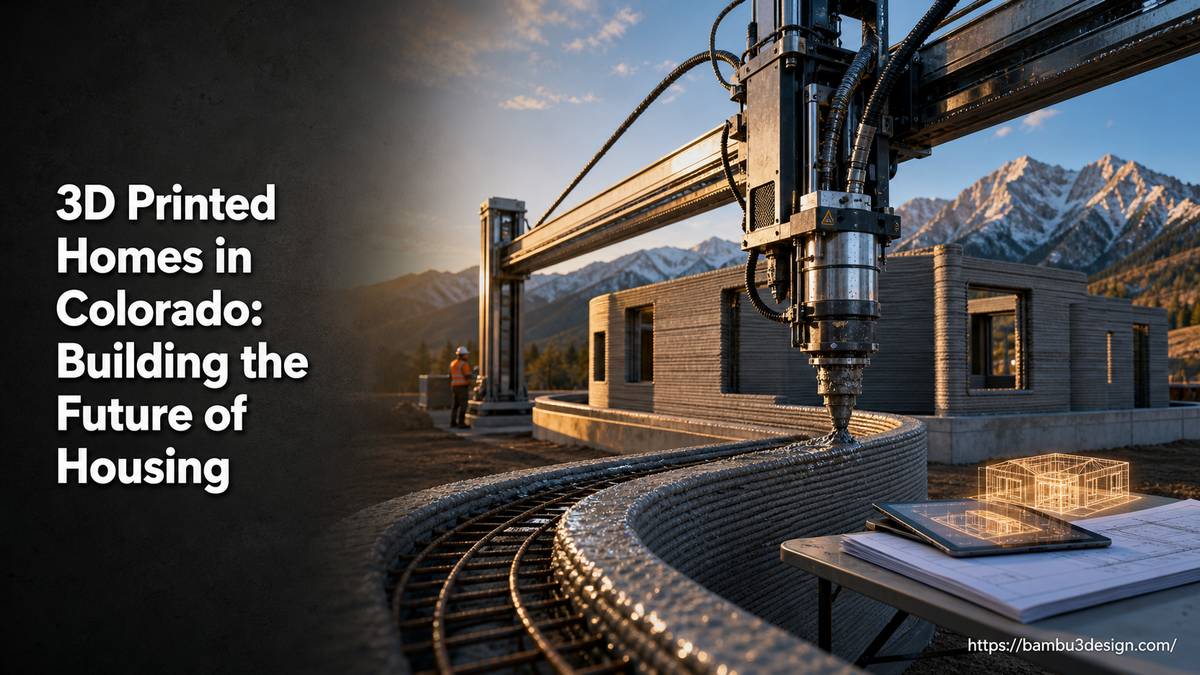
At the heart of these projects are large-scale 3D construction printers, often gantry systems, that precisely extrude specialized concrete mixtures. The process involves a robotic arm following a pre-programmed path, laying down layers of concrete to form walls and foundations. This method offers several key advantages:
- Speed: The superstructure of a 1,100 sq. ft. home can be completed in as little as 16 days. Foundation forms, which might typically take days for conventional construction, can be laid in a single day with a small crew.
- Automation: By automating repetitive tasks, 3D printers reduce the need for extensive manual labor, freeing up skilled workers for more complex finishing tasks.
- Material Efficiency: Precision printing minimizes material waste compared to traditional methods.
For instance, VeroTouch utilizes COBOD’s BOD2 3D printer for its projects, a technology known for its ability to print with real concrete and support an open-source material system. This adaptability allows builders to customize their printable material mix to local conditions, an essential feature for projects in diverse environments like Colorado.
Key Benefits of 3D Printed Homes in Colorado
The widespread adoption of 3D printed homes Colorado offers a multitude of benefits, particularly relevant to the state’s unique challenges:
- Enhanced Resilience and Fire Safety: Homes constructed with A1-rated 3D printed concrete walls offer the highest standard for fire safety. Unlike wood-frame houses, these concrete walls do not fuel combustion, providing a critical safety advantage in Colorado’s wildfire-prone regions. This resilience means homes can be expected to stand strong for a century or more.
- Faster Construction Timelines: The significant reduction in build time is a major draw. Accelerated timelines not only save weeks of construction work but also facilitate quicker project turnover and overall cost efficiency.
- Cost Efficiency: By improving labor productivity and streamlining the construction process, 3D printing contributes to lowering overall building costs. This is crucial for making housing more accessible and affordable.
- Design Flexibility: While some 3D printed homes showcase the characteristic layered concrete look, the technology also allows for versatile finishes, such as stucco, enabling designs that blend seamlessly with traditional aesthetics.
- Durability and Longevity: The use of robust concrete materials ensures a high level of structural integrity and longevity, creating “legacy homes” that can be passed down through generations.
Grant Hamel, CEO of VeroTouch, emphasizes this point: “In an era of fast housing, VeroTouch is creating legacy homes that can be passed down, rather than torn down. Beyond merely great design, we’re proud that VeroVistas homes offer a level of resilience to natural disasters like wildfires unmatched by any other product in this region.”
The Future of Residential Construction in Colorado
The initiatives in Colorado mark a significant shift in the construction paradigm. What was once confined to individual homes and demonstration projects is now evolving into integrated, scalable community solutions. Dr. Ryan Cox, CEO of RIC Robotics, highlights this progression: “Cleora represents a significant step forward because it demonstrates how robotics can be integrated into a real community at meaningful scale.”
Projects like Cleora and VeroTouch’s developments are vital proving grounds for understanding how technology can support future housing delivery, from construction efficiency and workforce development to long-term community growth. As 3D concrete printing technology continues to mature, its role in providing practical, resilient, and affordable housing solutions will undoubtedly expand, not just in Colorado but globally.
The widespread adoption of 3D printing in construction represents a tangible step towards a future where high-quality, sustainable, and accessible housing is a reality for more communities.