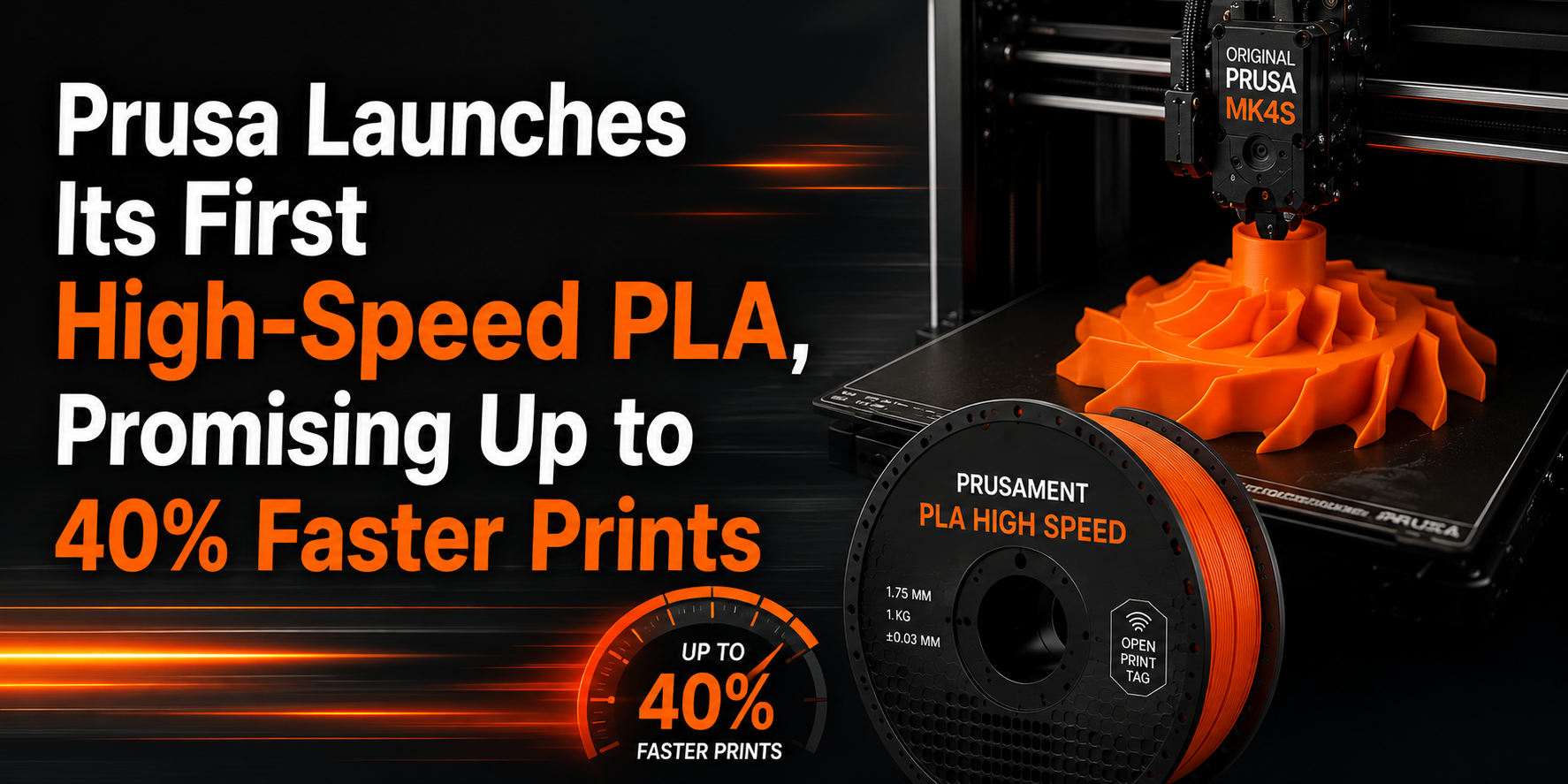
Prusa Research has officially introduced Prusament PLA High Speed, the company’s first high-speed PLA filament designed for users who want faster printing without sacrificing print quality. According to Prusa, the new filament can reduce print times by 20–40%, depending on the model and printing conditions.
Unlike many marketing claims in the 3D printing industry, Prusa backs its performance figures with internal testing and clearly explains the conditions under which these speed improvements can be achieved.
What Is Prusament PLA High Speed?
Prusament PLA High Speed is a newly developed PLA filament optimized for high-flow printing on compatible Prusa printers equipped with CHT Nextruder nozzles.
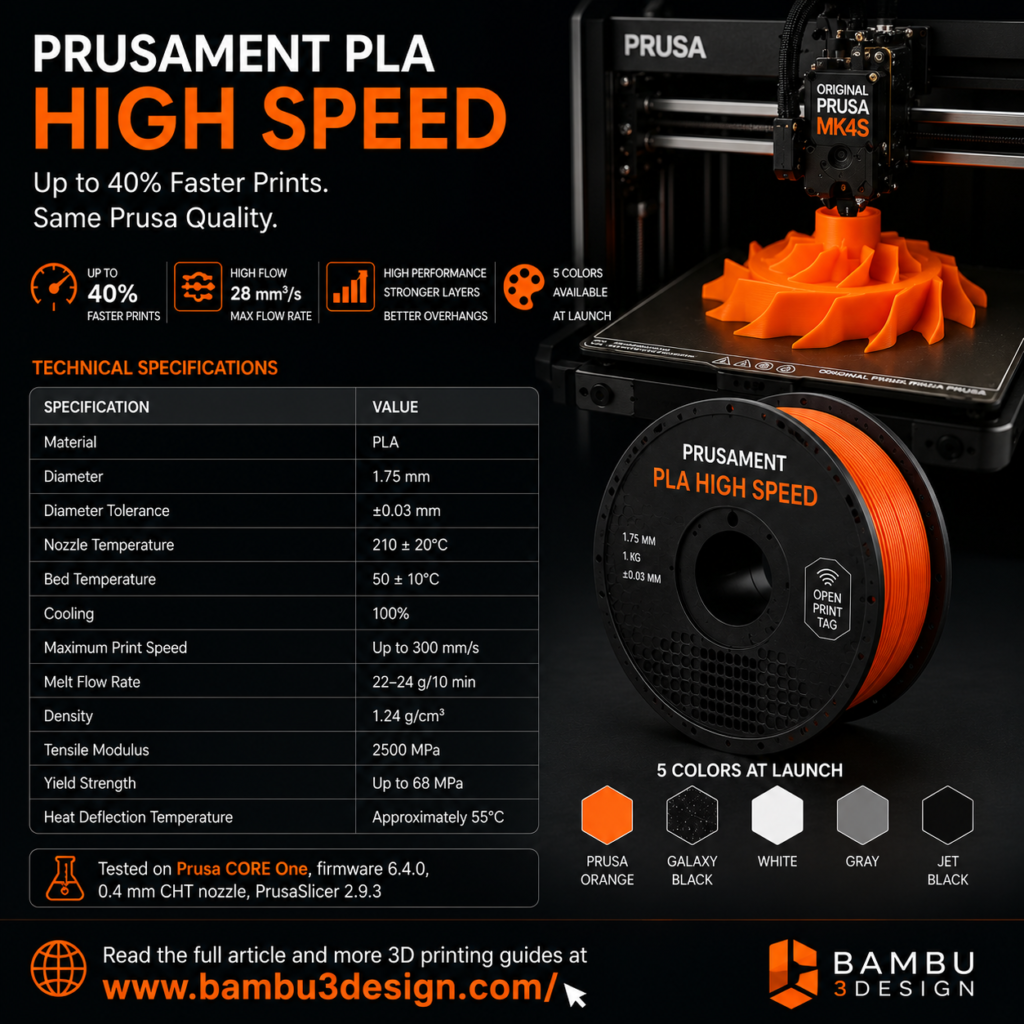
At launch, it is available in five colors, including:
- Prusa Orange
- Galaxy Black
- White
- Gray
- Jet Black
Each 1 kg spool retails for approximately $30.99 and includes an OpenPrintTag NFC chip for future smart filament identification.
Up to 40% Faster Printing
The biggest advantage of the new material is its ability to significantly reduce print times.
According to Prusa:
- 20–40% shorter print times
- Maximum volumetric flow rate of 28 mm³/s
For comparison:
| Filament | Maximum Volumetric Flow |
|---|---|
| Standard Prusament PLA | 24 mm³/s |
| Prusament PLA High Speed | 28 mm³/s |
Although the increase may appear small on paper, higher flow rates allow printers to maintain faster movement speeds while still extruding enough material, resulting in noticeable time savings on larger prints.
Why Is It Faster?
Prusa explains that the improvement comes from the material’s optimized melt rheology rather than simply increasing printing temperature.
The new filament features:
- Higher Melt Flow Index (MFI)
- Optimized shear-thinning behavior
In simple terms, the filament becomes less viscous as it flows through the nozzle at high speeds, allowing it to extrude more efficiently without compromising print quality.
Print Quality Improvements
Despite its focus on speed, Prusa says the new filament also offers several improvements over standard PLA.
According to the company, users can expect:
- Smoother and glossier surface finish
- More consistent extrusion
- Stronger layer adhesion
- Better overhang performance
- Improved mechanical strength
The only trade-off is that users may notice slightly more stringing compared to regular Prusament PLA.
Compatible Printers
To achieve the advertised performance, users must print with high-flow CHT nozzles.
Prusa recommends the filament for:
- Prusa MK4S
- Prusa CORE One
- Prusa CORE One+
These printers are capable of taking full advantage of the filament’s increased volumetric flow.
What About the Prusa XL?
The Prusa XL does not ship with a high-flow CHT nozzle.
Users who want to print with Prusament PLA High Speed at its intended speeds will need to upgrade to a compatible CHT High Flow nozzle.
MMU3 Users Should Take Note
Multi-material users may face a compromise.
Prusa advises against combining CHT Nextruder nozzles with the MMU3 because high-flow nozzles dramatically increase purge waste during filament changes.
For users who regularly print multi-color models, switching back to a standard nozzle may still be the better option.
As a result, Prusament PLA High Speed is currently best suited for single-material printing.
Is It Worth Buying?
If you own a modern Prusa printer equipped with a high-flow nozzle and want to reduce print times while maintaining excellent print quality, Prusament PLA High Speed is a compelling upgrade.
It is particularly well suited for users who:
- Print large models regularly
- Prioritize speed without sacrificing quality
- Primarily print single-material parts
- Own a MK4S or CORE One series printer
Users relying heavily on MMU3 for multi-color printing may not benefit as much due to increased purge waste.
Final Thoughts
With the launch of Prusament PLA High Speed, Prusa officially enters the growing market for high-speed filaments alongside brands such as Bambu Lab and Polymaker.
Rather than relying solely on marketing claims, Prusa has focused on measurable improvements in melt flow, layer adhesion, and print efficiency. When paired with compatible CHT High Flow nozzles, the new filament can deliver noticeably faster prints while preserving the reliability and print quality that Prusament is known for.
For owners of the Prusa MK4S and CORE One series, this new filament represents one of the easiest ways to boost productivity without upgrading the printer itself.