NASA’s Additive Manufacturing Quality Control: The Rise of In-Situ Monitoring
The frontier of space exploration demands innovation, and within this pursuit, additive manufacturing (AM), commonly known as 3D printing, has emerged as a cornerstone technology. NASA’s commitment to 3D printing has grown exponentially, shifting from a lower-tier priority to one of its top three strategic areas within a decade. This rapid integration highlights AM’s potential to create complex, lightweight, and cost-effective components critical for space missions.
However, the stakes in aerospace are exceptionally high. The principle of “garbage in, garbage out” is acutely relevant; the reliability of a final part is only as good as the quality data underpinning its production. For flight-critical hardware, ensuring flawless quality is paramount, yet traditional qualification processes for 3D printed components can be prohibitively lengthy and prone to high rejection rates. This is where advanced solutions like in-situ monitoring and multi-material additive manufacturing are transforming NASA additive manufacturing quality control and accelerating its adoption.
This article delves into how NASA and its partners, such as Phase3D and Space Copy, are pioneering next-generation 3D printing techniques to meet the rigorous demands of space, from real-time defect detection to autonomous multi-material fabrication.
The Critical Need for Quality in Space Additive Manufacturing
Additive manufacturing offers unparalleled advantages for aerospace applications, including the creation of intricate geometries, significant weight reduction, and the ability to produce parts on demand. These benefits are vital for missions where every gram counts and on-site repair capabilities could be a game-changer.
Despite its promise, the adoption of metal AM for space components faces substantial hurdles:
- High Rejection Rates: Metal additive manufacturing for space currently experiences rejection rates as high as 30% due to material defects.
- Lengthy Qualification Processes: The standard qualification timeline for a 3D printed space component can exceed eighteen months, often relying on time-consuming destructive testing and CT scanning post-production.
- Structural Integrity Concerns: The AM process can introduce defects such as residual stresses, micro-cracks, and pores, which can compromise the structural integrity of a part if not detected early.
These challenges underscore the urgent need for more efficient, reliable, and scalable methods of NASA additive manufacturing quality control. Traditional post-process inspection techniques are not only slow but also costly, as defects are only identified after significant time and material investment, leading to waste.
In-Situ Monitoring: Revolutionizing Quality Control with Phase3D
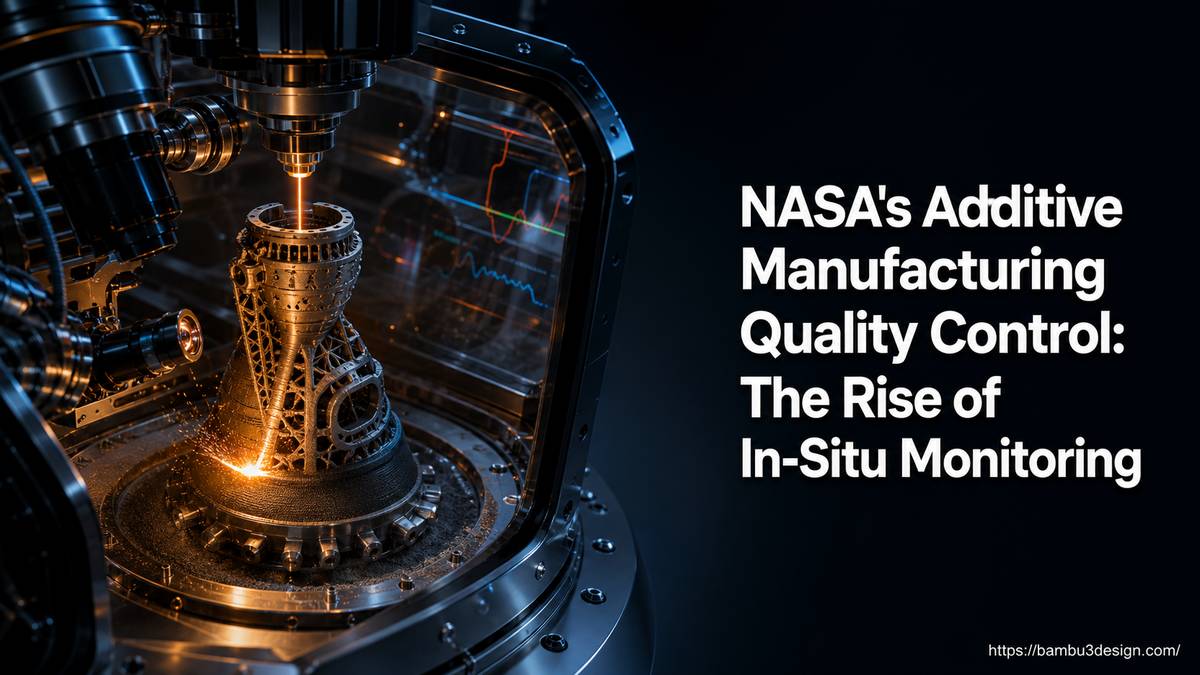
To address the limitations of post-production quality control, NASA is investing in in-situ monitoring (ISM) technologies. In-situ monitoring involves inspecting a part as it is being built, providing real-time data on every layer of the print process.
How Phase3D’s Project Fringe Works
Phase3D, a Chicago-based provider of hardware and software solutions for metal AM in-situ monitoring, has developed Project Fringe, an optical monitoring system designed to provide real-time, quantitative quality data. This patent-pending technology can be retrofitted to industrial 3D printers and operates by:
- Structured Light Technique: Utilizing a structured light technique to capture dense 3D measurements of dynamically changing surfaces during printing.
- Layer-Wise Data Capture: A sensor scans each powder layer and weld, capturing every anomaly with calibrated, defensible data.
- Defect Detection: This real-time measurement allows for immediate diagnosis of defects such as residual stresses, micro-cracks, and pores as they occur, rather than after the part is complete.
NASA’s Collaboration with Phase3D
NASA has contracted Phase3D to deploy its Fringe Inspection (hardware) and Fringe Qualification (software) systems to enhance NASA additive manufacturing quality control. Key aspects of this collaboration include:
- Deployment: Integration onto an EOS M300-4 quad laser machine.
- Test Cases: Evaluating the system’s effectiveness on structural brackets made from Invar 36 (an Iron-Nickel alloy) and high-performance copper components for NASA’s Liquid Propulsion Technology platforms.
- Anticipated Benefits: Phase3D aims to reduce the qualification timeline for space components by 2-3 times, significantly accelerating the process from over eighteen months to a fraction of that time. This capability provides higher confidence in final part quality and allows for immediate diagnosis of AM anomalies.
According to Dr. Niall O’Dowd, founder and CEO of Phase3D, this real-time inspection capability is “the foundation the industry needs to unlock AM at scale” for flight-critical hardware across aerospace, defense, and energy sectors.
Beyond Earth: Multi-Material and Autonomous AM with Space Copy
While NASA additive manufacturing quality control is critical, the agency’s vision for 3D printing extends to revolutionary capabilities like multi-material and autonomous fabrication, particularly for off-world applications. Space Copy, founded by Madison Feehan, is at the forefront of this next wave of innovation.
Space Copy’s advanced 3D printers are designed with extraordinary versatility:
- Multi-Material Capability: A single machine can process and print with polymers, ceramics, metals, and even regolith (lunar soil).
- Autonomous Operation: The printers are equipped to grind down local materials, identify their composition, and then print autonomously, enabling true on-demand manufacturing in remote or extraterrestrial environments.
- Lunar Deployment: Space Copy holds a NASA Space Act Agreement with an estimated lunar deployment slated for 2031, showcasing the agency’s commitment to in-situ resource utilization and manufacturing in space.
- Terrestrial Applications: Beyond space, the technology holds promise for remote terrestrial applications, such as printing critical parts like door hinges in the Arctic, where conventional replacements can take 6-8 weeks to ship.
This technology represents a significant step towards self-sufficiency for long-duration space missions and establishes a framework for future lunar or Martian bases, where resources are limited and resupply missions are impractical.
The Future of Additive Manufacturing for Space Exploration
The combined advancements in NASA additive manufacturing quality control through in-situ monitoring and the development of multi-material autonomous printers are charting a new course for space exploration. These innovations are not just about producing parts; they are about building trust, efficiency, and self-reliance in the most demanding environments.
By ensuring the structural integrity of 3D printed components in real-time and enabling the use of diverse on-site materials, NASA and its partners are:
- Accelerating Development Cycles: Reducing the time and cost associated with qualifying flight-critical hardware.
- Enhancing Reliability: Significantly lowering rejection rates and increasing confidence in part performance.
- Enabling New Missions: Paving the way for more ambitious and sustainable missions, including long-term human presence on the Moon and Mars.
- Broadening Impact: The technologies refined for space will inevitably influence and improve additive manufacturing processes across terrestrial industries like defense, energy, and biomedical applications.
The evolution of 3D printing, driven by the exacting requirements of space, promises a future where complex, high-performance parts can be fabricated with unprecedented speed, accuracy, and versatility, whether on Earth or beyond.
Conclusion
NASA’s strategic embrace of advanced additive manufacturing, particularly with a strong focus on NASA additive manufacturing quality control, marks a pivotal moment in the industry. The collaborative efforts with companies like Phase3D, through their groundbreaking in-situ monitoring solutions, are critical for validating the reliability of 3D printed components for the most demanding space applications. Simultaneously, Space Copy’s developments in multi-material autonomous printing offer a glimpse into a future of self-sufficient off-world manufacturing.
These innovations are not only reducing qualification times and mitigating risks but are also unlocking the full potential of 3D printing to support a new era of exploration and industrial application, setting new benchmarks for quality and versatility in advanced manufacturing.