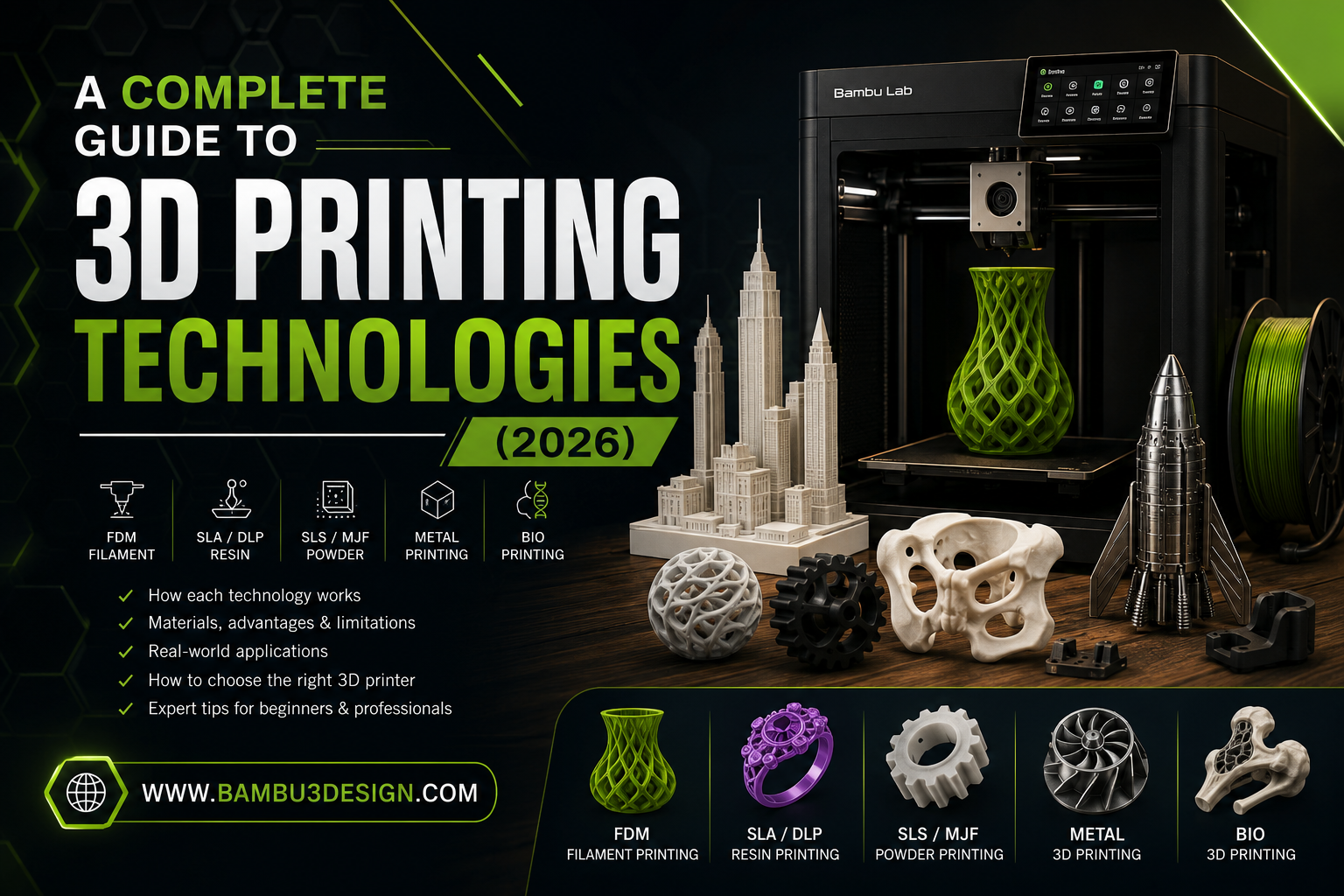
3D printing has transformed the way products are designed, prototyped, and manufactured. What once seemed like a futuristic concept is now an essential technology used by hobbyists, engineers, medical professionals, architects, and manufacturers around the world.
Today, there are many different types of 3D printers, each designed for specific applications and materials. Understanding how these technologies work can help you choose the right printer for your projects, whether you are creating prototypes, functional parts, artistic models, or industrial components.
What is 3D Printing?
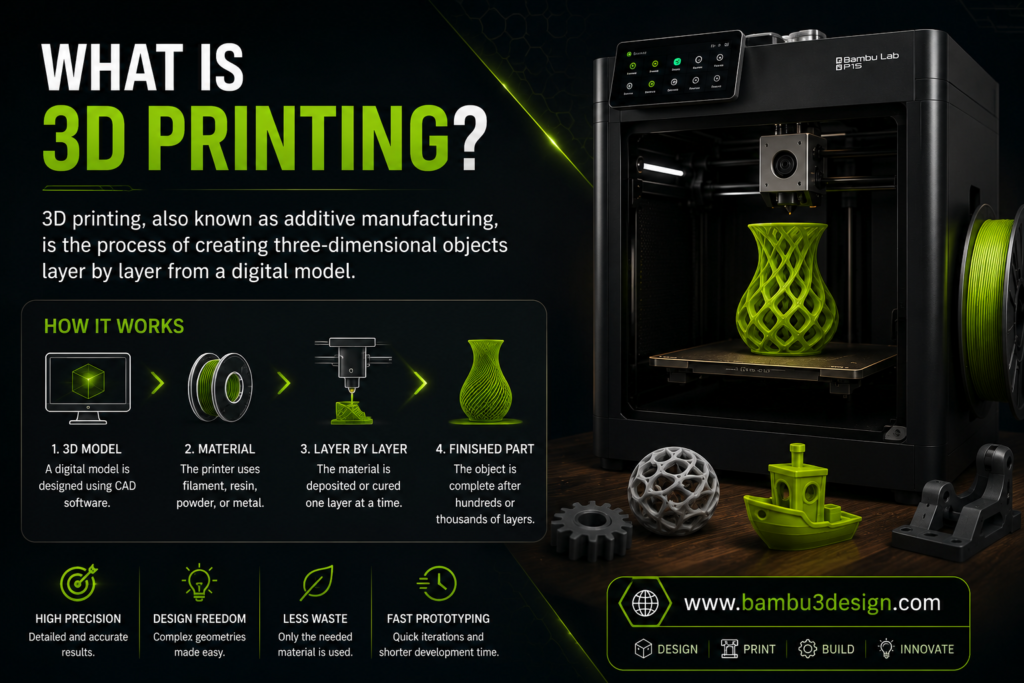
3D printing, also known as additive manufacturing, is the process of creating three-dimensional objects layer by layer from a digital model. Unlike traditional manufacturing methods that remove material through cutting or machining, additive manufacturing builds objects only where material is needed.
This approach reduces waste, shortens development time, and allows the creation of highly complex geometries that would be difficult or impossible using conventional manufacturing techniques.
Applications of 3D Printing
The versatility of 3D printing has made it one of the most important manufacturing technologies across many industries.
Product Development and Prototyping
Engineers and designers use 3D printers to quickly produce prototypes before moving to mass production. This significantly reduces development costs while allowing rapid testing and design improvements.
Medical Industry
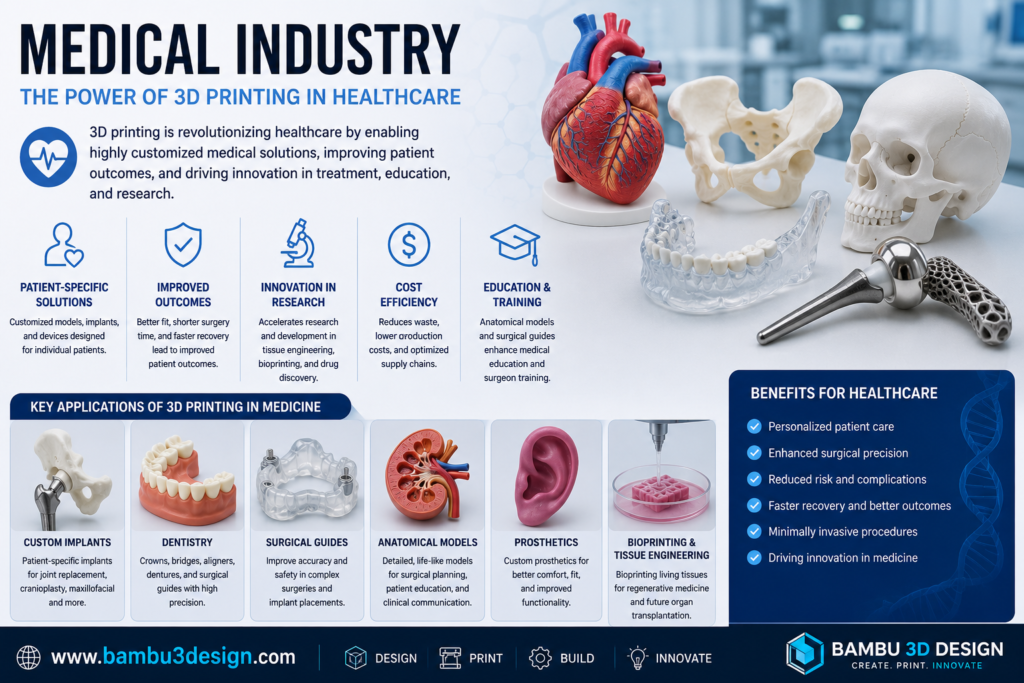
Healthcare has become one of the fastest-growing sectors for additive manufacturing.
Applications include:
- Patient-specific implants
- Dental crowns and aligners
- Surgical guides
- Prosthetic limbs
- Anatomical models for surgical planning
- Tissue engineering and bioprinting research
Customized medical devices improve patient outcomes while reducing surgical risks.
Aerospace Industry
Aircraft manufacturers use lightweight yet strong printed components to reduce aircraft weight, improve fuel efficiency, and simplify complex assemblies.
Automotive Industry
Automotive companies use 3D printing for:
- Rapid prototyping
- Functional testing
- Custom tools
- Lightweight performance parts
- End-use production components
Architecture
Architects create highly detailed scale models of buildings and urban developments much faster than traditional hand-built methods.
Education
Schools and universities use 3D printers to teach engineering, robotics, design, architecture, and manufacturing concepts through hands-on learning.
Art and Jewelry
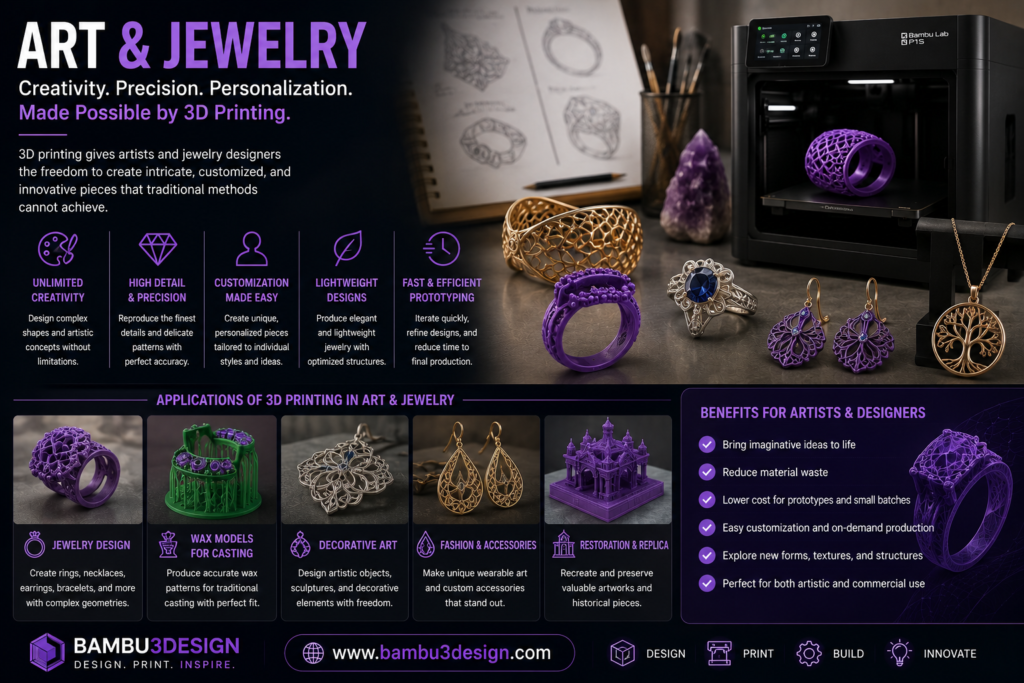
Artists can create sculptures with complex geometries, while jewelry designers produce intricate rings, pendants, and customized accessories with exceptional precision.
Types of 3D Printing Technologies
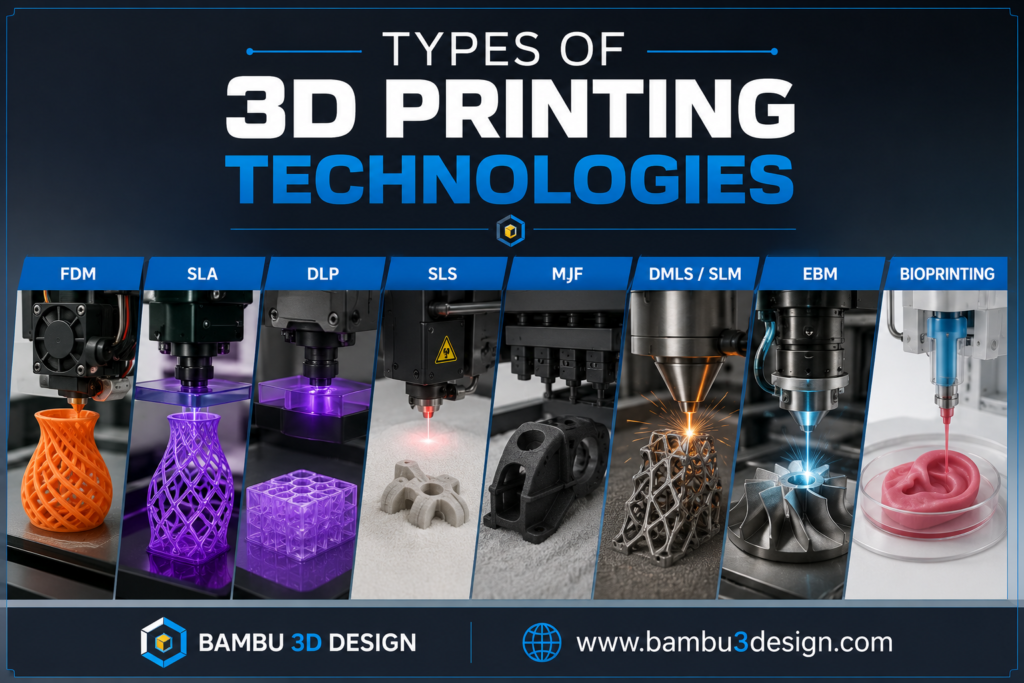
1. FDM (Fused Deposition Modeling)
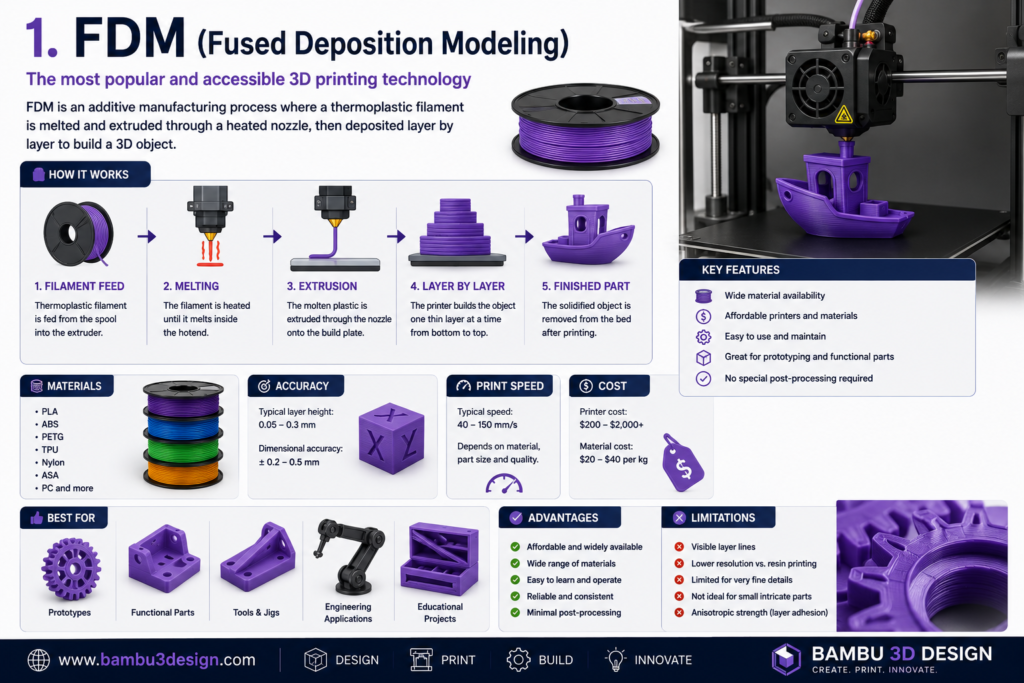
FDM is the world’s most popular 3D printing technology and is commonly used in homes, schools, and workshops.
How It Works
Plastic filament is fed into a heated nozzle where it melts and is deposited layer by layer onto the build plate until the object is complete.
Common Materials
- PLA
- PETG
- ABS
- ASA
- TPU
- Nylon
- Carbon Fiber Composites
Advantages
- Affordable printers
- Low material cost
- Easy maintenance
- Wide material selection
- Ideal for beginners
Disadvantages
- Visible layer lines
- Lower resolution than resin printing
- Support removal may be necessary
Best Applications
- Functional parts
- Household items
- Mechanical prototypes
- DIY projects
- Educational models
2. SLA (Stereolithography)
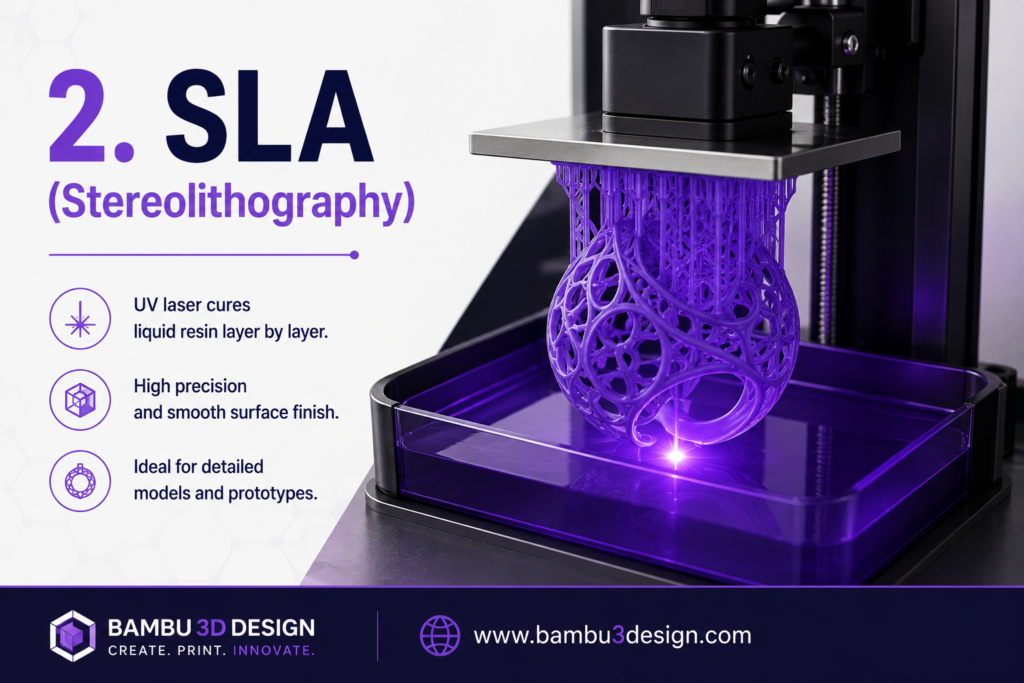
SLA is one of the oldest additive manufacturing technologies and offers exceptional surface quality.
How It Works
A UV laser selectively cures liquid photopolymer resin layer by layer inside a resin tank.
Advantages
- Extremely high accuracy
- Smooth surface finish
- Fine details
- Professional appearance
Disadvantages
- Higher equipment cost
- Resin handling requires care
- Post-curing is required
- Resin is more expensive than filament
Best Applications
- Dental models
- Miniatures
- Jewelry
- Engineering prototypes
- Medical devices
3. SLS (Selective Laser Sintering)
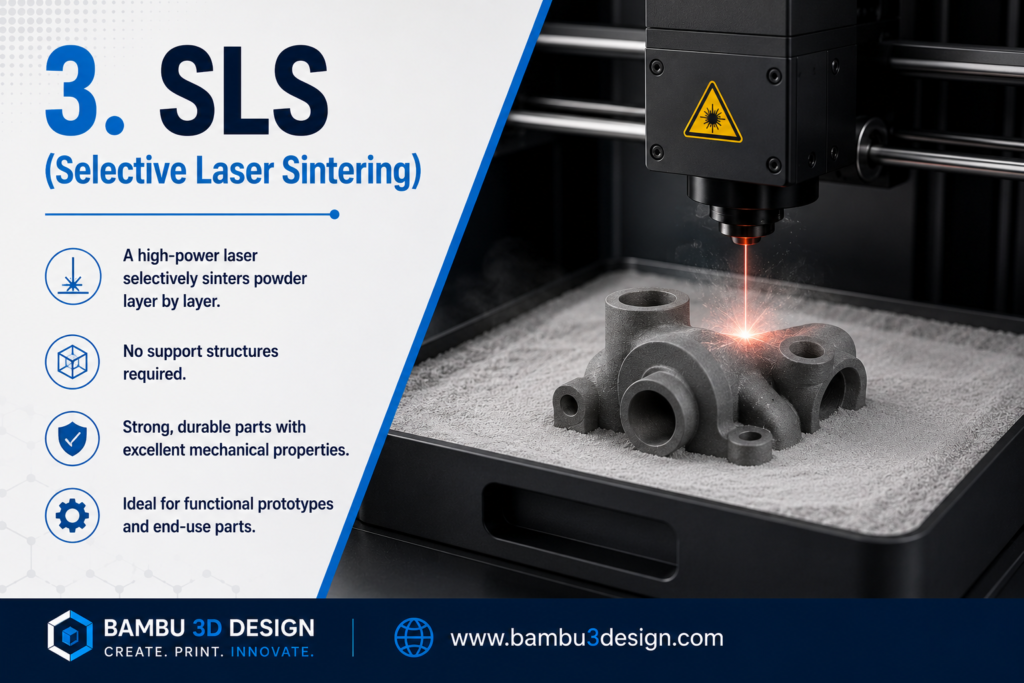
SLS uses a high-powered laser to fuse powdered materials into strong functional parts.
How It Works
A laser selectively sinters thin layers of nylon or polymer powder while unused powder supports the model.
Advantages
- No support structures required
- Excellent mechanical strength
- Complex geometries
- High production quality
Disadvantages
- Expensive equipment
- Powder handling
- Rougher surface finish
Best Applications
- Functional prototypes
- Industrial parts
- Aerospace components
- Automotive applications
4. DLP (Digital Light Processing)
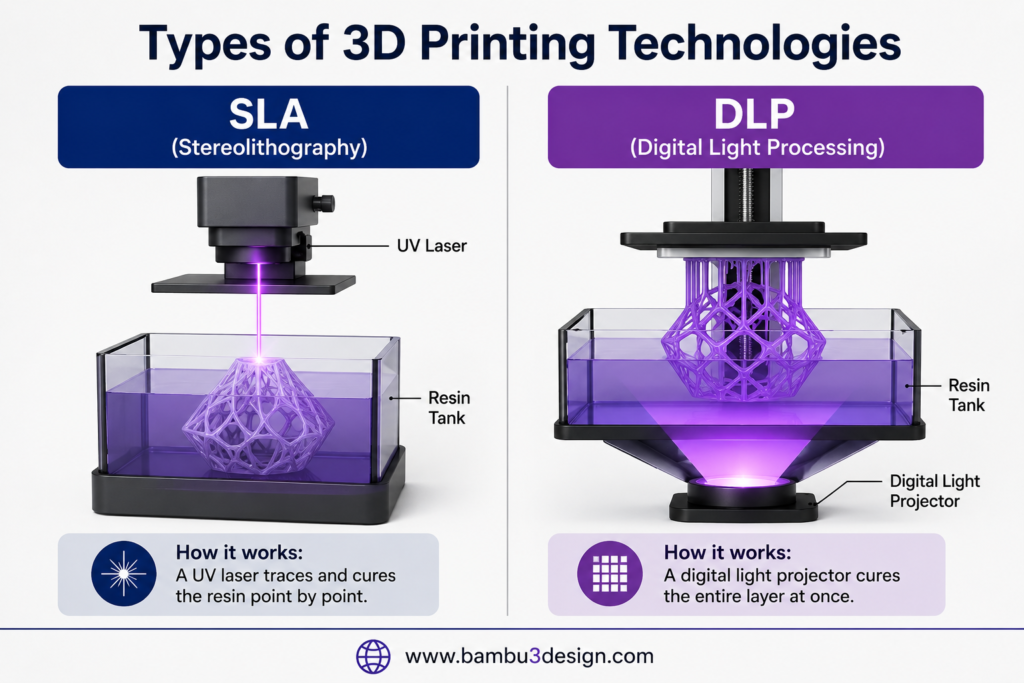
DLP is similar to SLA but uses a digital projector instead of a laser.
Advantages
- Faster printing
- Excellent detail
- Smooth surfaces
- High dimensional accuracy
Applications
- Jewelry
- Dentistry
- Medical models
- Small precision parts
5. MJF (Multi Jet Fusion)
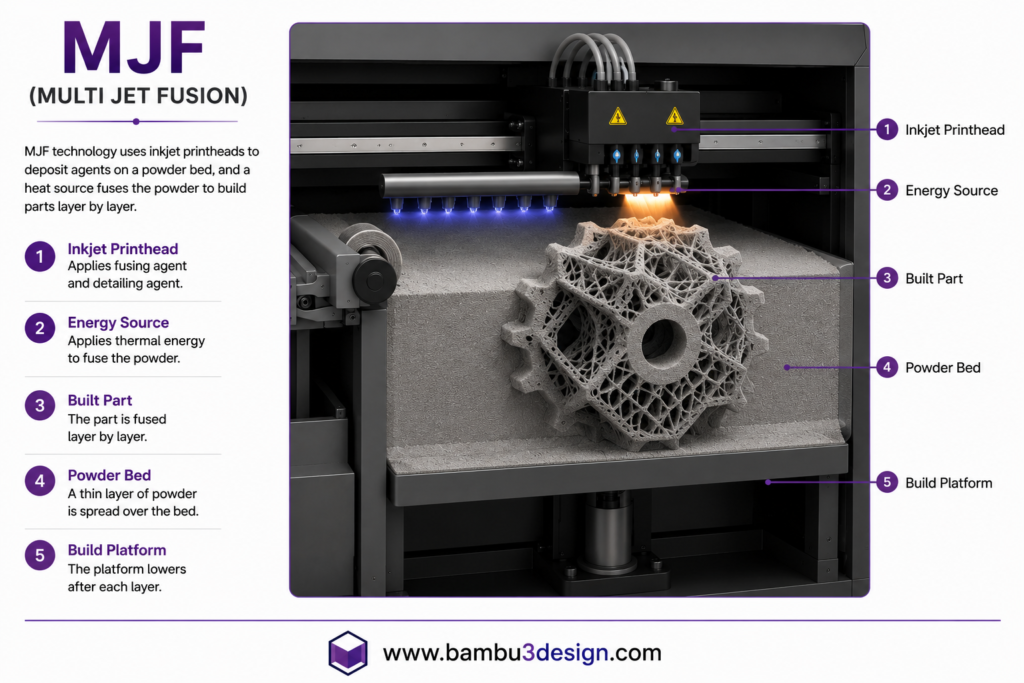
Developed by HP, MJF is one of the most advanced industrial additive manufacturing technologies.
How It Works
A layer of nylon powder is spread across the build platform. Special agents are deposited before infrared energy fuses the selected regions.
Advantages
- High production speed
- Excellent mechanical properties
- Consistent part quality
- Suitable for batch manufacturing
Applications
- End-use parts
- Industrial production
- Functional engineering components
6. EBM (Electron Beam Melting)
EBM melts metal powder using a focused electron beam inside a vacuum chamber.
Advantages
- Fully dense metal parts
- Excellent mechanical strength
- Reduced residual stress
- High material purity
Applications
- Aerospace
- Medical implants
- Titanium components
7. DMLS & SLM
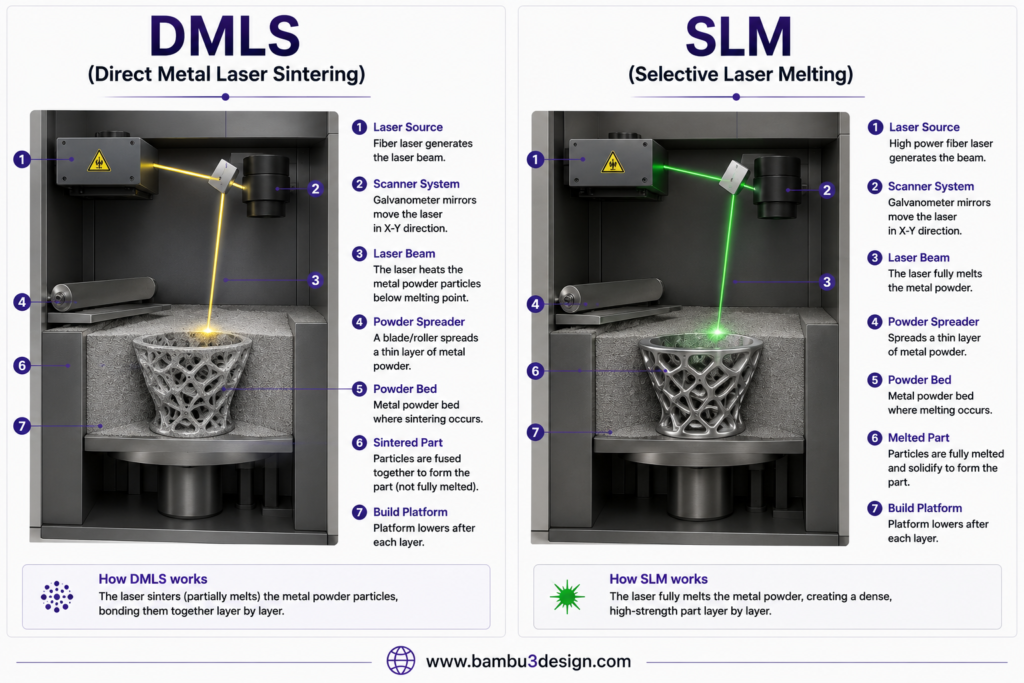
Both technologies use powerful lasers to manufacture fully metallic parts.
Common Materials
- Stainless Steel
- Titanium
- Aluminum
- Cobalt Chrome
- Inconel
- Tool Steel
Advantages
- High precision
- Complex geometries
- Strong metal components
- Production-grade quality
Applications
- Aerospace
- Automotive
- Medical implants
- High-performance engineering
8. Bioprinting
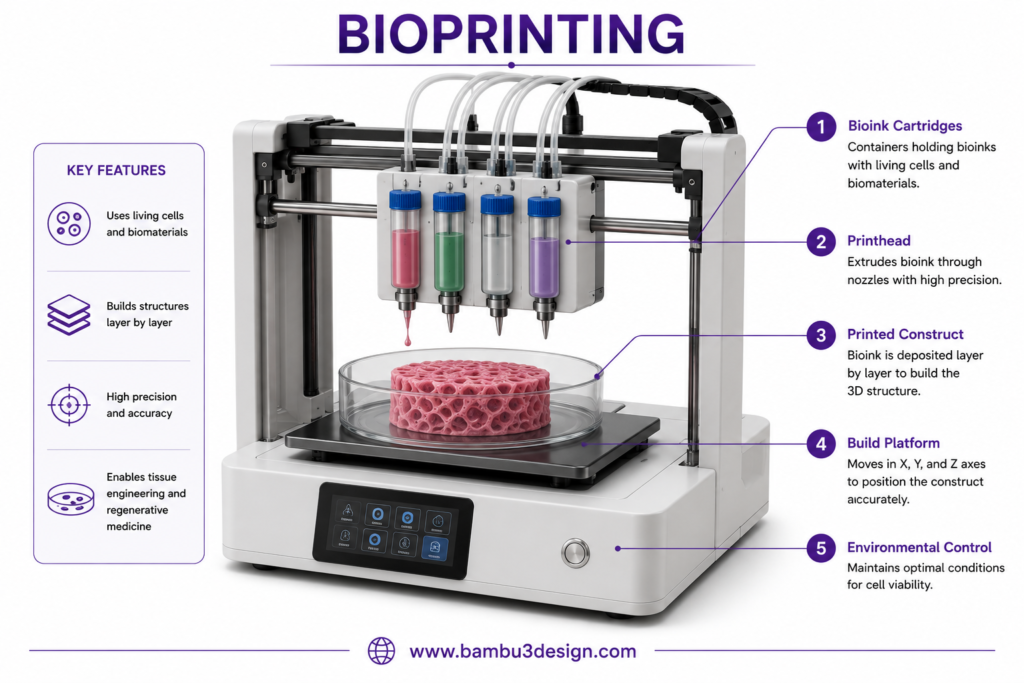
Bioprinting is one of the newest frontiers in additive manufacturing.
Instead of plastics or metals, bioprinters deposit living cells suspended in specialized bio-inks to create biological tissues.
Researchers are developing technologies capable of producing:
- Skin
- Blood vessels
- Cartilage
- Bone
- Heart tissue
- Organ models for drug testing
Although still under development, bioprinting has enormous potential for regenerative medicine and personalized healthcare.
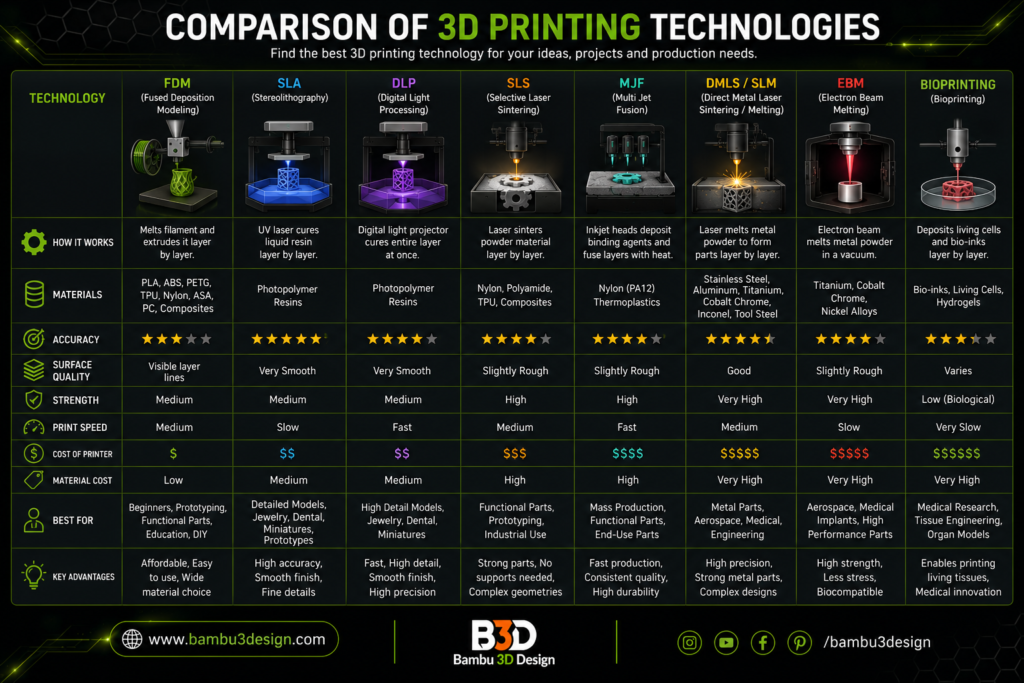
Which 3D Printing Technology Should You Choose?
Final Thoughts
3D printing continues to reshape manufacturing by enabling faster product development, greater design freedom, and highly customized production. Whether you’re a beginner exploring desktop FDM printers or an engineer working with industrial metal systems, choosing the right technology depends on your budget, materials, accuracy requirements, and intended application.
At Bambu3Design, we share practical tutorials, expert tips, original 3D models, and the latest innovations to help makers, designers, and engineers get the most from modern 3D printing technology.