As 3D printers become more common in homes, offices, classrooms, and shared living spaces, concerns about material safety and printing emissions are becoming increasingly important.
When heated, 3D printing filaments can release airborne particles and volatile organic compounds, commonly known as VOCs. The amount and type of these emissions depend on the material, printing temperature, filament formulation, printer setup, and ventilation conditions.
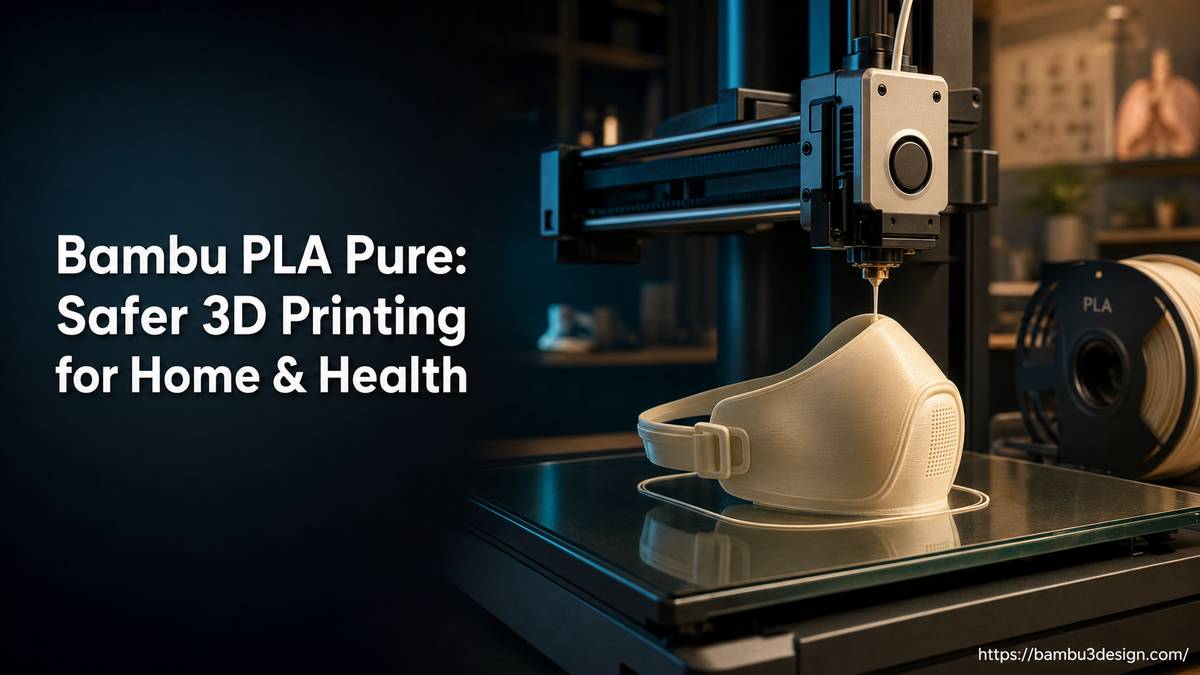
Bambu Lab developed Bambu PLA Pure with indoor printing and material transparency in mind. According to the manufacturer, this filament uses a simplified ingredient list, certified raw materials, and a formulation designed to reduce emissions without compromising print quality.
This article examines the composition, certifications, printing performance, and practical safety considerations of Bambu PLA Pure. It also explains an important distinction: a filament made from food-contact-compliant ingredients does not automatically produce a food-safe 3D printed object.
What Is Bambu PLA Pure?
Bambu PLA Pure is a specialized polylactic acid filament developed for users who want reliable PLA performance with greater transparency regarding material composition and emissions.
Like conventional PLA, its primary polymer is polylactic acid, a thermoplastic commonly produced from renewable sources such as corn starch or sugarcane. However, the main difference lies in how the complete filament formulation is controlled.
Many commercial filaments contain pigments, processing aids, impact modifiers, flow agents, fillers, and other additives. These ingredients may improve strength, flexibility, appearance, or printability, but their exact composition is not always clearly disclosed.
Bambu PLA Pure is presented as a more controlled alternative. Its formulation contains only five principal ingredients, each selected with traceability and safety certification in mind.
The “Pure” Approach: A Simplified Ingredient List
One of the defining characteristics of Bambu PLA Pure is its limited ingredient list.
According to Bambu Lab, each ingredient complies with the requirements of EU Regulation No. 10/2011, which concerns plastic materials intended to come into contact with food.
This approach differs from products that rely only on a general compliance claim for the finished filament. In the case of PLA Pure, the emphasis is placed on the individual ingredients, including the pigments and processing components.
The materials are also linked to identifiable Food Contact Material substance numbers, supporting greater traceability throughout the supply chain.
Bambu Lab states that raw materials are obtained from established global manufacturers, including companies such as TotalEnergies Corbion, Dow, Chemours, and BASF.
For users concerned about unknown additives, this level of transparency may offer greater confidence than a standard filament with limited compositional information.
The Five Main Ingredients
Bambu PLA Pure contains five primary components.
1. Polylactic Acid Base
Polylactic acid forms the main structure of the filament.
PLA is widely used in desktop 3D printing because it typically prints at relatively low temperatures, offers good dimensional accuracy, and is easier to handle than many engineering materials.
Its raw feedstock is commonly derived from renewable agricultural sources, including corn and sugarcane.
2. Acrylic Copolymer
An acrylic copolymer is included to modify the material’s processing or mechanical characteristics.
Similar classes of materials are commonly used in consumer products, including children’s toys.
3. Color Pigments
Pigments are used to produce the different filament colors.
Bambu Lab states that the pigments selected for PLA Pure are similar to those used in products such as children’s tableware and are included within the ingredient-level certification approach.
4. Ethylene Bis-Stearamide
Ethylene bis-stearamide, commonly abbreviated as EBS, is a processing additive used in many polymer applications.
It may help improve processing behavior and is also found in certain food-packaging materials.
5. Talc
Talc can be used as a mineral additive to influence processing, surface quality, dimensional stability, or mechanical behavior.
According to the supplied product information, the talc used in Bambu PLA Pure has been independently tested and verified as asbestos-free.
Understanding Emissions from 3D Printing
Material composition is only one part of safe 3D printing.
When filament passes through a heated nozzle, thermal processing may release airborne substances. The two main categories of concern are ultrafine particles and volatile organic compounds.
Ultrafine and Airborne Particles
Heating plastic can generate extremely small airborne particles.
Some particles are small enough to remain suspended in the air and potentially enter the respiratory system when inhaled.
The concentration of these particles may vary depending on:
- Filament chemistry
- Nozzle temperature
- Print duration
- Printer enclosure
- Ventilation
- Filament brand and additives
- Printer condition
- Printing speed
Materials printed at higher temperatures may produce greater emissions, although temperature is not the only factor involved.
Volatile Organic Compounds
Volatile organic compounds are chemicals that can enter the air during heating.
Not all VOCs have the same health effects. Some may primarily create odors, while others can irritate the eyes, skin, or respiratory system. Certain compounds may present greater risks at elevated concentrations or after prolonged exposure.
For this reason, even low-emission materials should be used in a reasonably ventilated environment.
PLA Pure Emission Certifications
Bambu PLA Pure is presented as meeting emission and product-safety standards relevant to indoor use.
UL GREENGUARD 2904
The filament carries UL 2904 GREENGUARD certification, a standard used to evaluate chemical and particle emissions associated with 3D printers and printing materials.
Testing under this type of standard may assess factors such as:
- Particulate emissions
- PM2.5
- PM10
- Volatile organic compounds
- Indoor air-quality impact
The certification does not mean that printing produces absolutely no emissions. Instead, it indicates that the tested product remained within the limits defined by the relevant standard under specified test conditions.
Toy-Safety Compliance
PLA Pure is also described as meeting European toy-safety requirements.
This may make it a more reassuring option for printing decorative objects or toys that children may handle. However, users should still consider the complete printed object, including its shape, durability, coatings, small components, and intended age group.
A safe filament alone does not guarantee that a finished toy is suitable for every child or every use.
How PLA Pure Reduces Emissions
The lower-emission performance of PLA Pure is linked to its carefully controlled formulation.
Filaments often contain additives introduced to improve:
- Impact resistance
- Flow behavior
- Flexibility
- Surface appearance
- Print speed
- Heat resistance
- Layer bonding
Some additives may contribute to emissions when heated.
By limiting the number of ingredients and selecting components with documented compliance, PLA Pure is designed to reduce unnecessary sources of off-gassing and airborne particles.
According to the supplied information, laboratory testing over a four-hour continuous printing period showed lower PM2.5 and PM10 emissions than a comparable third-party filament tested under similar conditions.
However, real-world emission levels can differ from controlled laboratory results. Room size, airflow, printer enclosure, temperature settings, and print duration all influence indoor exposure.
Is Bambu PLA Pure Food Safe?
This question requires a careful distinction.
The ingredients used in Bambu PLA Pure may comply with regulations for plastic materials intended for food contact. However, this does not automatically mean that every object printed from the filament is safe for direct or repeated food use.
There is an important difference between:
- A food-contact-compliant raw material
- A food-safe manufacturing process
- A food-safe finished product
Material Certification
Ingredient certification primarily addresses the chemical suitability of the raw materials under defined conditions.
It can help reduce concerns about substances migrating from the plastic itself. However, the final printed object is affected by additional factors that are not covered by filament composition alone.
Printer Contamination
A 3D printer may previously have processed other materials containing pigments, additives, glass fibers, carbon fibers, flame retardants, or unknown substances.
Residue can remain in:
- The nozzle
- The hotend
- The extruder path
- The build plate
- Internal filament channels
A brass nozzle may also contain small amounts of other metals. Consequently, even a compliant filament may become contaminated during printing.
Layer Lines and Porosity
Fused deposition modeling creates objects one layer at a time.
Small gaps and grooves can remain between the deposited lines. These surfaces may trap:
- Food particles
- Moisture
- Oils
- Cleaning residues
- Bacteria
Complex internal cavities can be particularly difficult to clean thoroughly.
Even when the surface appears smooth, microscopic gaps may remain. Repeated washing and mechanical wear may also create additional scratches.
Post-Processing Materials
Sanding, painting, gluing, coating, and sealing can introduce additional substances.
Unless every material used in the finishing process is suitable for the intended food-contact conditions, the completed object should not be assumed to be food safe.
For these reasons, caution is recommended when using standard FDM prints for eating, drinking, food preparation, or long-term food storage.
The value of PLA Pure in this context is primarily its controlled ingredient formulation. It reduces uncertainty about the filament itself but does not eliminate all risks associated with the printer and the layer-based manufacturing process.
Printing Performance
A simplified ingredient list can make filament development more challenging.
Many manufacturers rely on additives to improve flow, toughness, surface quality, or printing consistency. Removing or reducing those components may negatively affect printability unless the remaining formulation is carefully optimized.
Bambu Lab states that PLA Pure was developed through numerous formulation iterations to maintain reliable printing performance while avoiding many conventional modifiers.
Clean Printing
PLA Pure is designed to produce clean surfaces with limited stringing.
Reduced stringing can provide several advantages:
- Less cleanup after printing
- Cleaner gaps between separate features
- Improved appearance
- Reduced need for sanding
- Easier assembly of multi-part models
Actual stringing performance still depends on printer calibration, nozzle temperature, retraction settings, humidity, and model geometry.
Although PLA is generally less moisture-sensitive than materials such as nylon, drying may still improve quality when a spool has absorbed moisture during storage.
Mechanical Properties
Despite the simplified formulation, PLA Pure is intended to deliver mechanical performance comparable to Bambu Lab PLA Basic.
This makes it suitable for many typical PLA applications, including:
- Decorative models
- Prototypes
- Organizers
- Toys
- Display pieces
- Light-duty functional components
- Household accessories
- Educational models
As with most PLA filaments, it may not be the best choice for parts exposed to high temperatures, strong impacts, long-term outdoor use, or heavy mechanical loads.
Who Is Bambu PLA Pure Best For?
Bambu PLA Pure may be particularly useful for several groups of users.
People Printing in Living Spaces
Some users operate printers in bedrooms, living rooms, apartments, or home offices because a dedicated workshop is unavailable.
A lower-emission filament may be preferable in these settings, although ventilation and exposure management remain important.
Homes with Children or Pets
Households with children or pets may place greater importance on material transparency and indoor air quality.
PLA Pure may provide additional reassurance because of its limited ingredient list and emission testing. However, children and animals should still be kept away from moving printer components, hot nozzles, heated beds, filament waste, and small printed parts.
Users Who Value Ingredient Transparency
Many filaments are sold without detailed information about their additives.
PLA Pure may appeal to makers who prefer to understand what their material contains and who value documented ingredient traceability.
Makers Producing Toys and Decorative Objects
The material may be useful for toys, models, decorative parts, and household objects.
Nevertheless, designers should consider the entire product rather than only the filament. Sharp edges, detachable components, choking hazards, strength, and coatings must also be evaluated.
Users Seeking Standard PLA Performance
PLA Pure is intended for users who want the convenience of PLA while prioritizing lower emissions and material transparency.
It aims to provide these safety-related benefits without significantly compromising surface quality, strength, or printing reliability.
Practical Safety Recommendations
Even when using a lower-emission filament, good printing practices remain important.
Provide Adequate Ventilation
Operate the printer in a room with sufficient airflow.
Opening a window or using appropriate mechanical ventilation can help reduce the concentration of airborne particles and VOCs.
Avoid Prolonged Close Exposure
Avoid sitting directly beside an operating printer for several hours, particularly during long print jobs.
Placing the printer in a separate room or dedicated workspace can reduce unnecessary exposure.
Use an Enclosure When Appropriate
An enclosure can help contain particles, stabilize temperatures, and isolate moving or heated components.
However, an enclosure should not be treated as a complete substitute for ventilation. Opening it immediately after printing may release accumulated emissions into the room.
Allowing time for the printer to cool and airborne particles to settle may help reduce exposure.
Consider Air Filtration
Filters containing activated carbon and high-efficiency particulate filtration may help reduce certain emissions.
Their effectiveness depends on:
- Filter quality
- Airflow
- Seal quality
- Filter size
- Replacement schedule
- Type of emitted compounds
Keep the Printer Clean
Regularly remove filament debris, dust, failed-print material, and residue from the build chamber.
A clean machine can reduce odors, contamination, and the risk of loose material contacting hot components.
Store Filament Properly
Keep filament dry and protected from dust.
Moist filament can produce bubbling, stringing, inconsistent extrusion, and reduced surface quality.
Limitations to Consider
Bambu PLA Pure offers several attractive features, but it should not be interpreted as a risk-free material.
Important limitations include:
- Low emissions do not mean zero emissions.
- Laboratory results may not represent every printer or room.
- Food-contact-compliant ingredients do not automatically create food-safe prints.
- Toy-safety compliance does not guarantee that every printed design is child-safe.
- PLA still has limited heat resistance.
- Mechanical performance depends on orientation, layer adhesion, and print settings.
- Proper ventilation is still recommended.
Users should evaluate the complete printing environment and intended application rather than relying on a single certification.
Conclusion
Bambu PLA Pure represents an effort to make desktop 3D printing more suitable for indoor and residential environments.
Its main advantages include a simplified ingredient list, enhanced raw-material traceability, emission certification, and printing performance designed to remain comparable to conventional PLA.
For users who print in apartments, home offices, classrooms, or other shared spaces, these characteristics may make it a more reassuring choice than filaments with limited compositional information.
However, PLA Pure should not be viewed as completely emission-free, and it does not automatically make finished prints food safe. Printer contamination, layer-line porosity, post-processing materials, room ventilation, and the intended use of the final object all remain important.
For makers who value indoor air quality, ingredient transparency, and dependable PLA performance, Bambu PLA Pure may offer a practical balance between safety-focused formulation and everyday printability.