Introduction
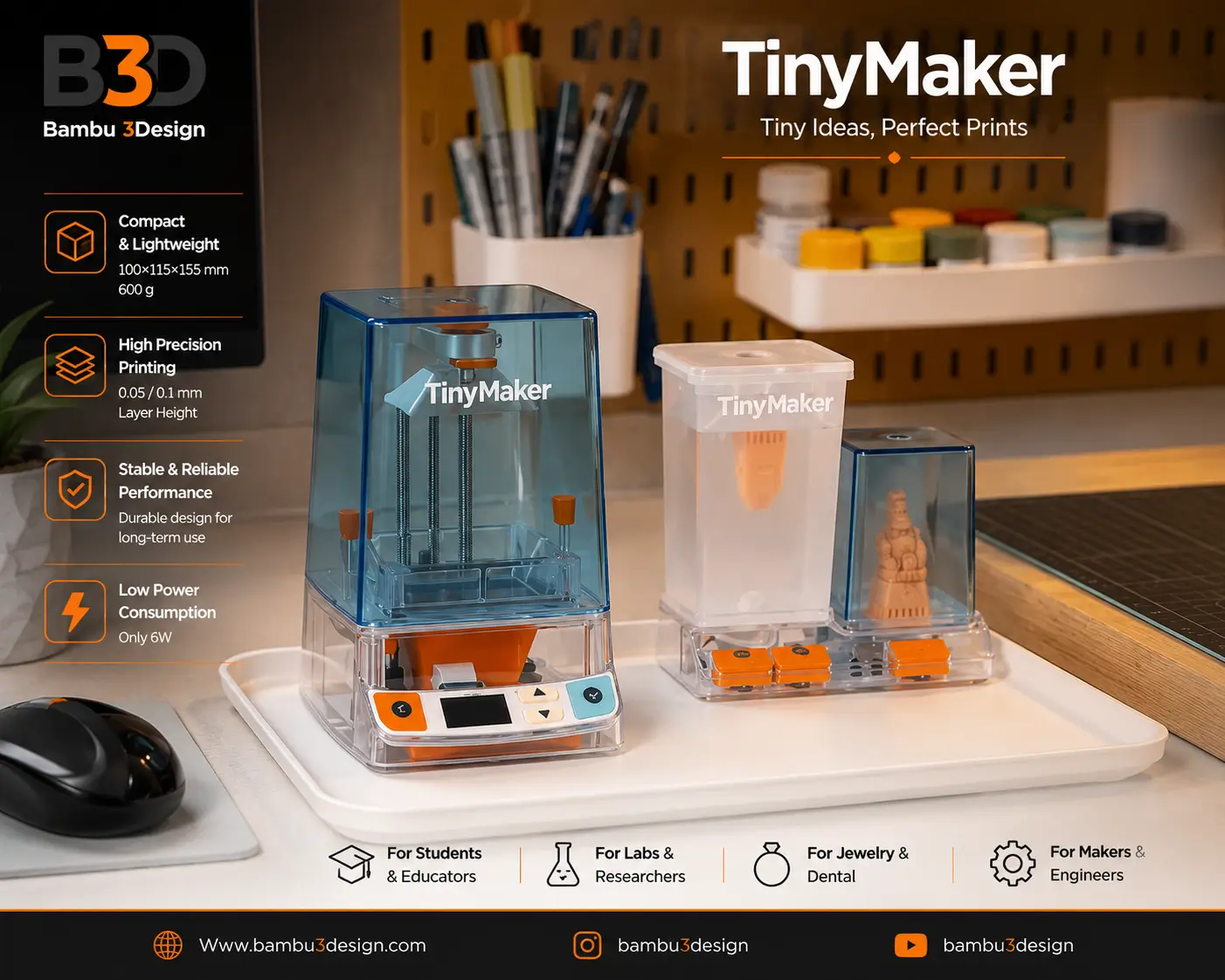
Resin 3D printing has become increasingly popular among hobbyists, engineers, researchers, and professionals who require highly detailed parts. TinyMaker is one of the smallest desktop resin 3D printers available, offering a compact design while maintaining the ability to produce detailed prints for a variety of applications.
Developed over more than two years of research, prototyping, and engineering, TinyMaker has gone through several design iterations before reaching its final production version. In this article, we explore its specifications, design process, advantages, limitations, and the types of users who can benefit most from this compact resin printer.
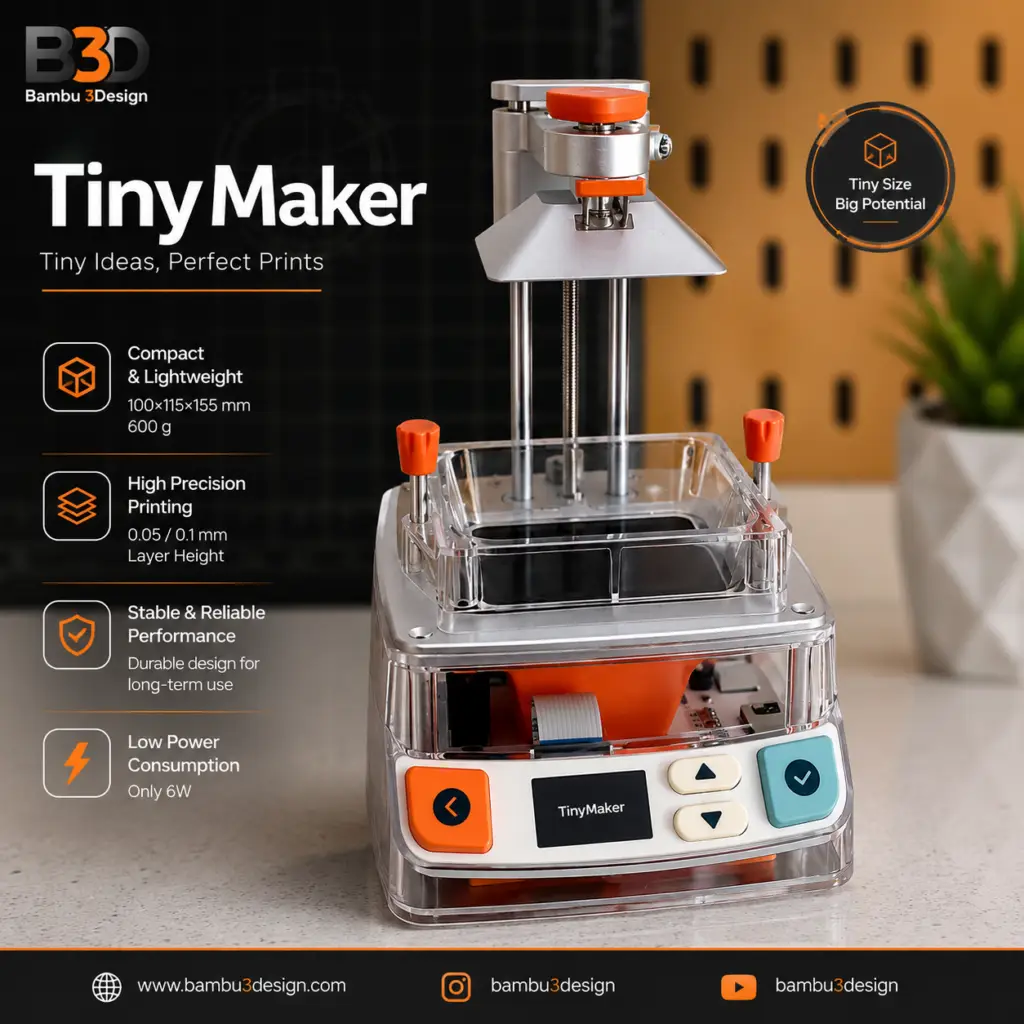
TinyMaker Specifications
- Printer Dimensions: 100 × 115 × 155 mm
- Weight: 600 g
- Build Volume: 30.6 × 40.8 × 60 mm
- LCD Resolution: 240 × 320 pixels
- Layer Height: 0.05 mm or 0.1 mm
- Compatible Resins: Third-party UV resins
- Supported Software: Chitubox and PrusaSlicer
- Data Transfer: Micro SD Card
- Power Consumption: 6 W
- Power Input: 5V / 2A
A Truly Compact Resin Printer
One of TinyMaker’s most attractive features is its extremely compact size. Measuring just 100 × 115 × 155 mm and weighing only 600 grams, it easily fits on almost any desk, laboratory bench, or workshop.
Its low power consumption also makes it an energy-efficient option for users who frequently print small components.
Although its build volume is relatively small, it is well suited for applications that require fine details rather than large print sizes.
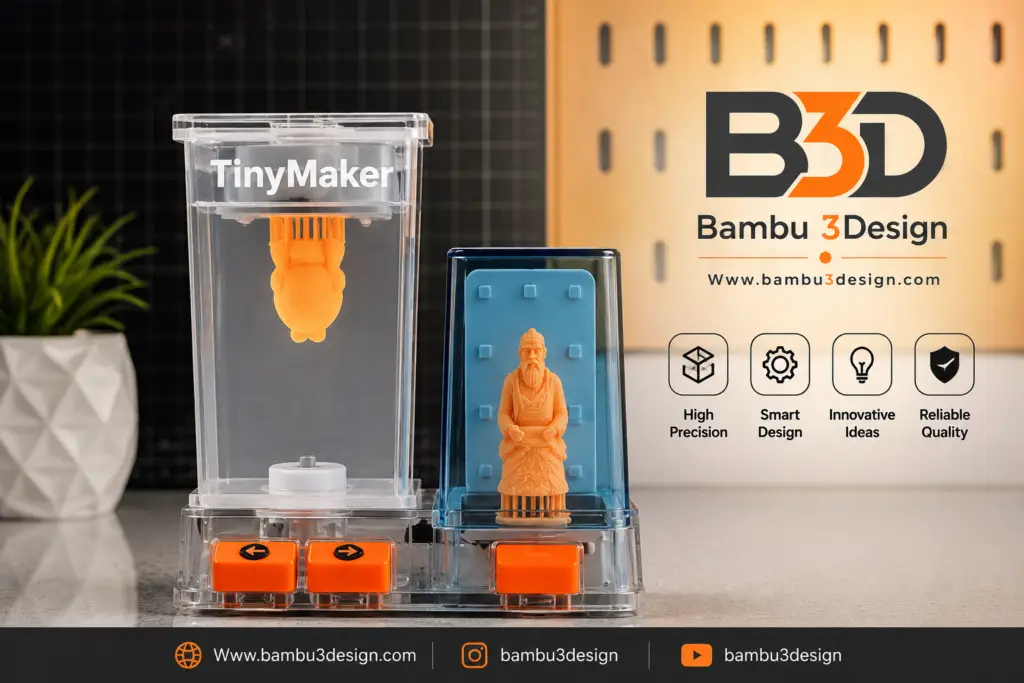
Development Journey
Rather than rushing the product to market, the TinyMaker development team spent over two years refining every aspect of the printer.
Functional Prototype
The earliest prototype focused on validating the printer’s core functionality. It used an Arduino-based controller, hand-machined metal components, and served primarily as a proof of concept.
Assembly Verification Prototype
After confirming the design concept, the team redesigned the printer for manufacturing. During this phase, they introduced an injection-molded enclosure, optimized the mechanical assembly, and upgraded the electronics by replacing the original Atmel controller with an ESP32.
Design for Manufacturing (DFM)
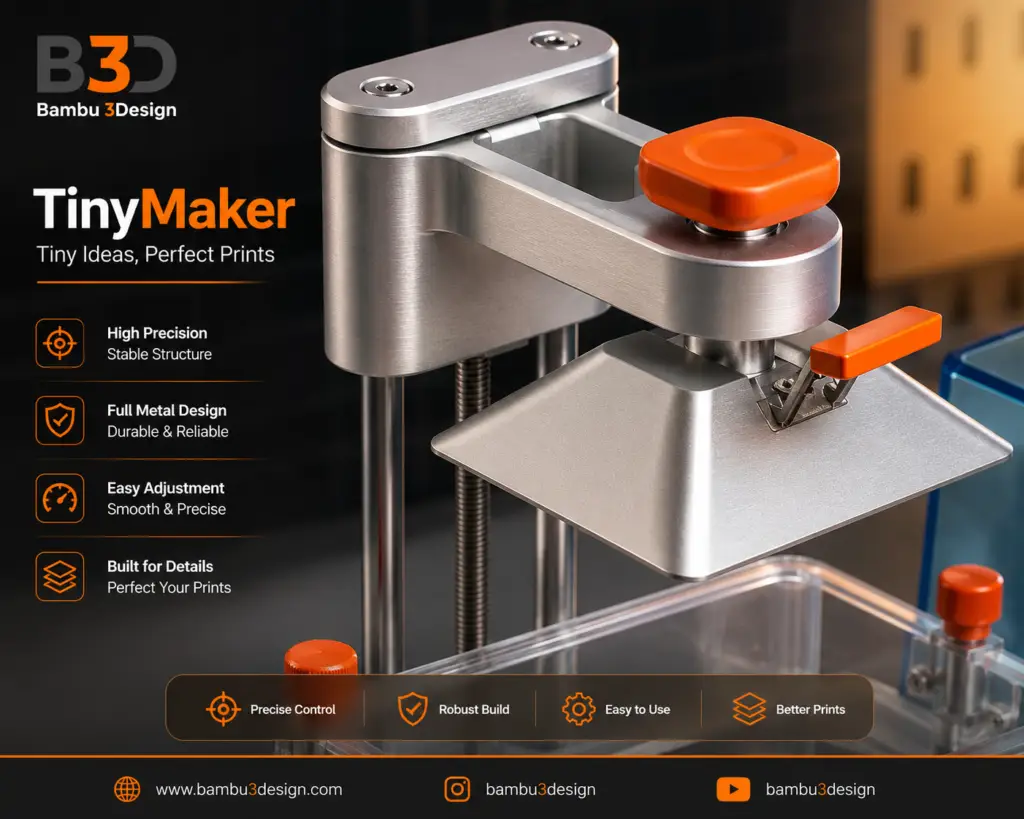
The final production-ready prototype features precision CNC-machined metal parts, refined industrial design, optimized electronics, and improved manufacturing consistency.
This gradual development process helped improve reliability, ease of assembly, and overall print quality.
Software Compatibility
TinyMaker supports two of the most widely used slicing programs:
- Chitubox
- PrusaSlicer
This allows users to prepare models using familiar software without requiring proprietary applications.
Print Quality
The printer supports layer heights of 0.05 mm and 0.1 mm, making it capable of producing detailed models suitable for:
- Miniatures
- Jewelry prototypes
- Dental models
- Engineering parts
- Educational projects
- Electronic enclosures
- Microfluidic devices
- Biomedical research
For users printing very small components, the compact build volume is generally sufficient while helping maintain efficient print times.
Advantages
TinyMaker offers several advantages for users looking for a small desktop resin printer:
- Extremely compact and lightweight design
- Low power consumption
- Compatible with third-party resins
- Supports popular slicing software
- Easy to transport
- Suitable for laboratories, classrooms, and home workshops
- Ideal for small, high-detail prints
Limitations
Like any compact resin printer, TinyMaker also has some limitations.
Its build volume is relatively small, making it unsuitable for larger models.
The LCD resolution (240 × 320 pixels) is lower than many modern 2K, 4K, 8K, and 12K resin printers, meaning users seeking the highest possible XY resolution may prefer newer high-resolution systems.
Additionally, file transfer is performed via a Micro SD card rather than built-in wireless connectivity.
Who Should Consider TinyMaker?
TinyMaker is best suited for users who value portability and compactness over large print capacity.
It can be an excellent choice for:
- Hobbyists
- Students
- Engineers
- University laboratories
- Researchers
- Jewelry designers
- Dental professionals
- Electronics makers
- Anyone printing small, detailed resin models
Final Thoughts
TinyMaker demonstrates that a resin 3D printer does not need to be large to be useful. Its compact footprint, lightweight construction, and compatibility with standard resin materials make it an attractive option for users working with small precision models.
While its limited build volume and modest LCD resolution may not satisfy every professional application, it offers an interesting solution for educational environments, research laboratories, and hobbyists looking for a portable resin printer.
Watch TinyMaker in Action
Reading specifications and product descriptions is helpful, but seeing a printer in real-world use provides a much better understanding of its capabilities.
To help you get a closer look at the TinyMaker, I have prepared two dedicated videos for this printer.
The first video is a complete unboxing, where I show everything included in the package, take a close look at the printer’s design, and discuss the accessories that come with it.
The second video is a hands-on demonstration showing the complete setup process, basic operation, and how to use the TinyMaker for resin 3D printing. In this video, you can see the workflow from preparing the printer to printing a model, making it easier to understand how the machine performs in practice.
You can watch both the unboxing video and the step-by-step operation guide below to see the TinyMaker in action before deciding if it is the right resin 3D printer for your projects.