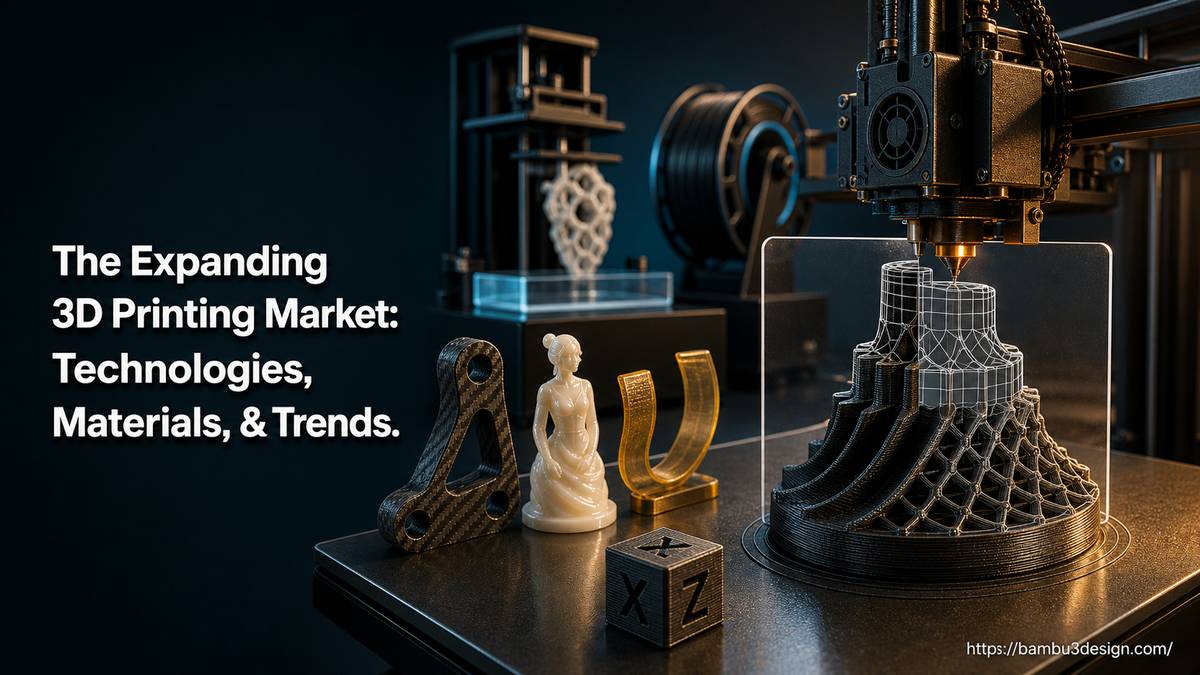
The landscape of manufacturing is continually reshaped by innovation, and few technologies demonstrate this more clearly than 3D printing, also known as additive manufacturing. What began as a niche prototyping tool has rapidly evolved into a cornerstone of industrial production, driving customization, efficiency, and new design possibilities across virtually every sector.
For engineers, designers, and hobbyists alike, understanding the dynamics of the 3D printing market is crucial. This guide provides an in-depth look at the market’s impressive growth, the core technologies powering it, the diverse materials it utilizes, and the transformative trends that are shaping its future.
The Expanding 3D Printing Market: Key Growth Indicators
The 3D printing market is in a phase of accelerated expansion, transitioning from a specialized process to a mainstream manufacturing solution. This growth is underpinned by significant financial investment and increasing adoption rates globally.
Market Size and Future Projections
The financial trajectory of the 3D printing market reflects its increasing impact. In Q1 2025, the market reached an estimated $3.58 billion. Looking further ahead, the overall 3D printing industry was valued at $13.33 billion in 2024. Projections indicate a rapid ascent, with the market expected to grow to $15.9 billion by 2025 and an impressive $92.38 billion by 2035. This represents a compound annual growth rate (CAGR) of 19.24% between 2025 and 2035, signaling a robust and sustained expansion.
Driving Forces Behind Market Growth
Several factors are propelling the 3D printing market forward:
- Customization and Personalization: The ability to produce unique, tailored parts on demand is a significant driver, especially in consumer goods, medical devices, and specialized industrial components.
- Technological Advancements: Continuous improvements in printer speed, accuracy, material compatibility, and automation are making additive manufacturing more viable for broader applications.
- Cost Reduction in Manufacturing: 3D printing can reduce material waste, simplify complex assemblies, and shorten lead times, leading to overall manufacturing cost efficiencies.
- Advancements in Material Science: The development of new and enhanced materials—including high-performance polymers, advanced metals, and specialized ceramics—is expanding the range of functional applications.
- Increased Demand for Prototyping: While moving beyond solely prototyping, 3D printing remains invaluable for rapid iteration and design validation, accelerating product development cycles.
Regional Market Dynamics
The global growth isn’t uniform, with distinct regional strengths:
- North America currently holds the largest share of the 3D printing market, driven by significant R&D investments and early adoption across key industries.
- Asia-Pacific is emerging as the fastest-growing region, fueled by increasing investments in advanced manufacturing infrastructure and a growing industrial base.
The market composition also shows interesting trends, with the hardware segment continuing to dominate in terms of market share, while services are rapidly gaining traction as a key area of growth, reflecting the increasing complexity and demand for specialized additive manufacturing solutions.
Core 3D Printing Technologies Driving Innovation
Additive manufacturing encompasses various technologies, each with distinct principles, material compatibility, and ideal applications. Understanding these core methods is key to appreciating the market’s diversity.
Fused Deposition Modeling (FDM / FFF)
FDM, or Fused Filament Fabrication (FFF), is one of the most widely recognized and accessible 3D printing technologies. It works by extruding a thermoplastic filament through a heated nozzle, depositing successive layers onto a build platform to construct an object. As each layer cools and solidifies, the next is added until the print is complete. FDM printers are known for their versatility, ease of use, and cost-effectiveness, making them popular for both industrial prototyping and desktop applications. Brands like Bambu Lab, Ultimaker, and Prusa are prominent players in this segment.
Stereolithography (SLA)
Stereolithography (SLA) is a resin-based 3D printing technology renowned for producing high-resolution, finely detailed objects with smooth surface finishes. SLA printers utilize a UV laser to selectively cure (harden) liquid photopolymer resin layer by layer. This process allows for intricate geometries and tight tolerances, making it highly suitable for applications requiring precision, such as dental models, jewelry, and detailed prototypes. Formlabs is a key innovator in the SLA space.
Selective Laser Sintering (SLS)
Selective Laser Sintering (SLS) is a powder-bed fusion technology that uses a high-power laser to fuse small particles of polymer powder into a solid structure. The unsintered powder acts as a natural support for the printed part, allowing for complex geometries without the need for additional support structures. SLS parts are known for their mechanical strength and durability, making them ideal for functional prototypes and end-use components in engineering and manufacturing.
Direct Metal Laser Sintering (DMLS) and Other Metal AM
Direct Metal Laser Sintering (DMLS) is a specialized additive manufacturing process that builds metal parts layer by layer from metal powder using a laser. Similar to SLS, DMLS is a powder-bed fusion technique but designed for metals, producing robust, functional metal components. This technology, along with other metal additive manufacturing (AM) methods, is crucial for industries requiring high-strength, lightweight parts, such as aerospace, automotive, and medical implants. Companies like GE Additive and EOS are leaders in metal AM.
Essential Materials Shaping Additive Manufacturing
The functionality and application range of 3D printing are directly tied to the materials available. Significant advancements in material science are expanding what can be achieved with additive manufacturing.
Polymer Filaments and Resins
Polymers are the most common material type in 3D printing, especially for FDM and SLA technologies:
- PLA (Polylactide): A popular and biodegradable thermoplastic filament, known for its ease of use and suitability for general-purpose printing and educational applications.
- PETG (Polyethylene Terephthalate Glycol): Offers a good balance of strength, flexibility, and temperature resistance, making it more durable than PLA.
- ABS (Acrylonitrile Butadiene Styrene): Known for its strength, toughness, and temperature resistance, often used for functional parts, though it requires specific printing conditions.
- Resins: Photopolymer resins are used in SLA and similar processes, offering a wide range of properties from rigid and tough to flexible and castable, allowing for high detail and smooth finishes.
Metal and Ceramic Materials
Beyond plastics, the use of metal and ceramic materials is vital for industrial 3D printing, enabling the creation of high-performance parts:
- Metal Powders: Used in DMLS and other metal AM processes, these include alloys like stainless steel, titanium, aluminum, and nickel-based superalloys, producing parts with properties comparable to traditionally manufactured metals.
- Ceramic Materials: While less common than polymers or metals, ceramic 3D printing is emerging for applications requiring high heat resistance, chemical inertness, and specific electrical properties.
Diverse Applications Across Key Industries
The versatility of 3D printing has led to its widespread adoption across a multitude of industries, transforming product development and manufacturing processes.
Rapid Prototyping and Tooling
One of the earliest and still most significant applications of 3D printing is rapid prototyping. It allows designers and engineers to quickly produce physical models of their designs, iterate on them, and validate concepts at a fraction of the time and cost of traditional methods. Beyond prototypes, 3D printing is increasingly used for creating custom tools, jigs, and fixtures, optimizing manufacturing workflows and enhancing production efficiency.
End-Use Parts and Production
Additive manufacturing is moving beyond mere prototyping to produce functional end-use parts. This shift is driven by improved material properties, increased machine reliability, and the ability to create complex geometries not possible with conventional manufacturing. Industries are leveraging 3D printing for low-volume production, mass customization, and decentralized manufacturing of specific components.
Industry-Specific Adoption
- Aerospace: Used for lightweight, complex components that improve fuel efficiency and performance, often using high-strength metal alloys.
- Automotive: Adoption is accelerating for rapid prototyping, specialized tooling, and custom internal components, helping to reduce development cycles and improve vehicle performance.
- Healthcare: A backbone of additive manufacturing, encompassing personalized medical implants, prosthetic limbs, dental aligners, surgical guides, and anatomical models for training.
- Education: 3D printing provides hands-on learning experiences, fostering innovation and design skills among students.
- Manufacturing Aids: Creation of custom grippers, fixtures, and other aids on the factory floor to streamline operations.
Emerging Trends and the Future of 3D Printing
The 3D printing market is not static; it is constantly evolving with new trends and technological integrations that promise to redefine manufacturing.
Customization and On-Demand Production
The ability to create highly customized products on demand is a core advantage of 3D printing. This trend allows businesses to offer personalized solutions to customers, reduce inventory costs, and respond rapidly to market changes. From bespoke fashion items to patient-specific medical devices, personalization is a key differentiator.
Sustainability and Material Innovation
With a growing global emphasis on sustainability, the 3D printing market is seeing a drive towards eco-friendly materials and processes. This includes the development of recyclable and biodegradable filaments (like PLA), as well as optimized printing strategies that minimize waste. Advancements in material science are also exploring new composites and multi-material printing capabilities.
Integration of Advanced Technologies
The future of 3D printing will be deeply intertwined with other advanced technologies:
- Digital Fabrication Technologies: Enhancing the seamless transition from digital design to physical production.
- Artificial Intelligence (AI) and Machine Learning: Optimizing print settings, predicting failures, and automating design processes.
- Internet of Things (IoT): Connecting printers for remote monitoring, predictive maintenance, and optimized fleet management.
- Collaboration and Digital Twin: Fostering greater collaboration between designers and engineers through shared digital models and digital twin concepts, leading to more innovative applications and streamlined supply chains.
Conclusion
The 3D printing market is a dynamic and rapidly expanding sector, demonstrating remarkable growth and transformative potential. Driven by continuous technological innovation, advancements in material science, and increasing industrial adoption, additive manufacturing is redefining what’s possible in design and production. From its foundational technologies like FDM, SLA, and SLS to its diverse applications across healthcare, automotive, and aerospace, 3D printing is not just a tool for the future, but a critical component of modern manufacturing today. As the market continues its upward trajectory, its influence on customization, sustainability, and efficiency will only become more pronounced, solidifying its role as an indispensable technology for global industries.