Nature has been refining micro-injection systems for millions of years. We’re only now starting to appreciate how sophisticated they really are.
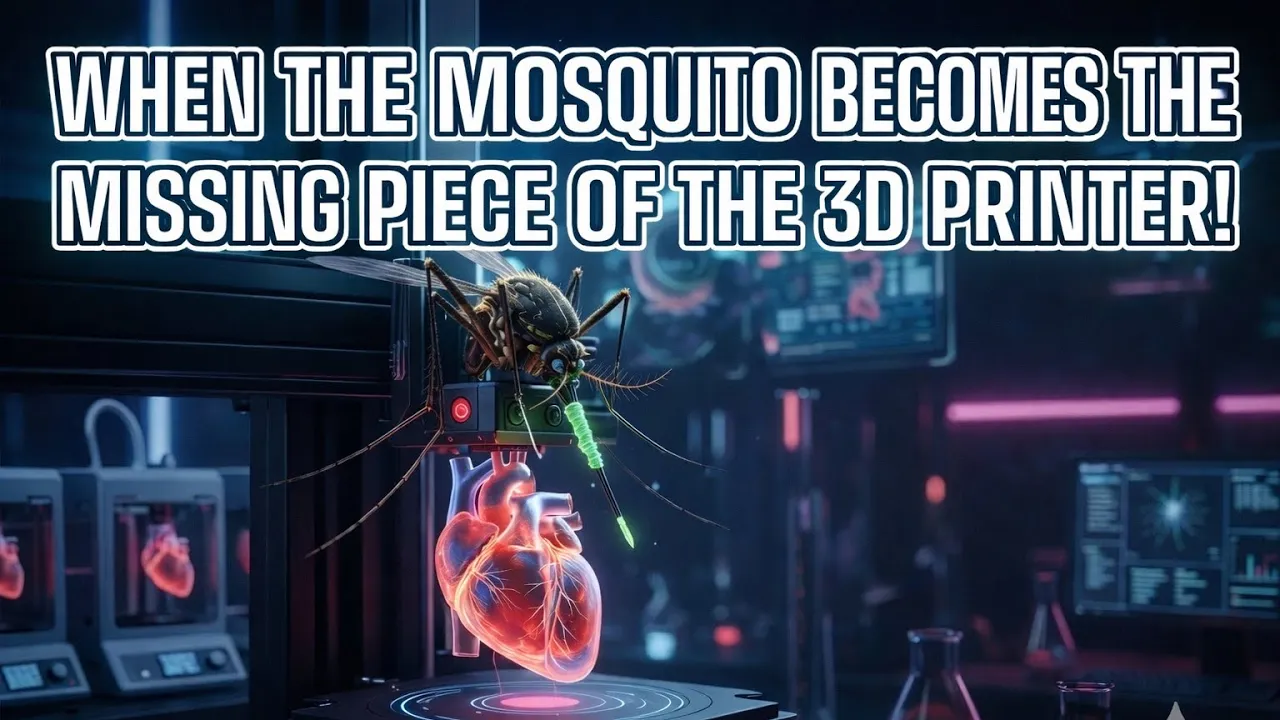
In this video, we explore a fascinating bio-inspired concept: using the mosquito’s proboscis as a model—or even a structural template—for advanced bioprinting nozzles. Traditional commercial bioprinter nozzles are expensive and often struggle with clogging when extruding viscous bioinks. In contrast, the mosquito’s mouthpart evolved to deliver fluids efficiently, with minimal damage and remarkably smooth flow characteristics. That makes it an unexpected but powerful source of engineering inspiration.
By reinforcing the natural structure with specialized resin, researchers created a mechanically stable, highly precise extrusion tool. The result is microscopic printing accuracy combined with up to 86% cell viability during bioink extrusion—an essential parameter for tissue engineering applications such as vascular structures or cardiac tissue models.
In this video, we discuss:
- Why nozzle clogging is a critical bottleneck in bioprinting
- How bio-inspired design can outperform conventional hardware
- What 86% cell survival really means for tissue fabrication
- And whether this approach could significantly reduce costs in biomedical manufacturing
Sometimes innovation doesn’t come from building something new—it comes from observing what evolution has already optimized. This time, a mosquito may be pointing the way toward the future of bio-printing.