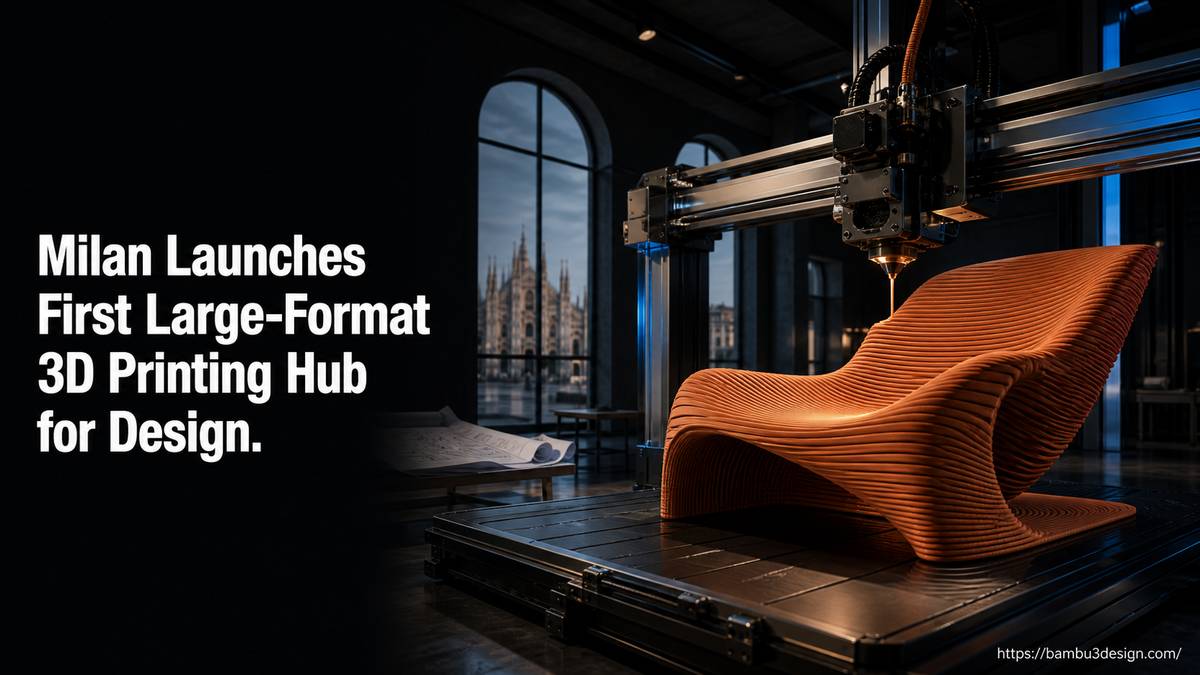
Milan Launches First Permanent Large-Format 3D Printing Hub for Design
Milan, a global capital of design, has recently become home to a groundbreaking facility: its first permanent hub dedicated to robotic large-format additive manufacturing (LFAM) for design applications. This significant development is the result of a partnership between Milan-based companies Caracol and Designtech, alongside Barcelona-based LAMÁQUINA, bringing advanced industrial 3D printing technology directly to the Italian design sector.
The new hub aims to empower Italian designers, studios, and brands by providing direct access to state-of-the-art additive manufacturing capabilities. This initiative marks a new era for industrial-grade fabrication within the design industry, enabling the creation of large-scale, complex, and customized components that were previously challenging to produce.
Advancing Design with Robotic Large-Format Additive Manufacturing
At the core of this new Milanese hub is robotic large-format additive manufacturing. This technology distinguishes itself from traditional desktop 3D printing through several key aspects:
- Scale: Unlike smaller desktop FDM printers, LFAM systems can produce objects that are significantly larger, often reaching several meters in dimension. This is crucial for applications such as architectural elements, bespoke furniture, and large prototypes.
- Robotic Integration: The use of robotic arms provides unparalleled flexibility and precision. These robots can maneuver print heads over vast build volumes and complex geometries, allowing for highly customized and intricate designs.
- Industrial-Grade Capabilities: The hub focuses on industrial-grade technology, meaning higher reliability, faster production cycles, and the ability to process a wider range of engineering-grade materials suitable for functional parts and end-use products.
- Design-Oriented Application: The hub’s explicit focus on design means tailoring the technology to meet the aesthetic, functional, and structural demands of various design disciplines, from product design to architecture.
Impact on the Italian Design Industry
The establishment of this large-format 3D printing hub is poised to revolutionize several aspects of the Italian design landscape:
- Accelerated Prototyping: Designers can rapidly iterate and produce large-scale prototypes, significantly shortening development cycles for new products and architectural models.
- Customization and Bespoke Production: The technology enables the creation of highly customized furniture, interior design elements, and artistic installations tailored to specific client needs or project requirements.
- Geometric Freedom: Robotic additive manufacturing liberates designers from traditional manufacturing constraints, allowing for the exploration of organic shapes, complex textures, and intricate internal structures that are difficult or impossible with conventional methods.
- Material Exploration: While specific materials offered by the hub are not detailed, industrial LFAM often utilizes a broad spectrum of polymers, including reinforced composites, offering designers new possibilities for material properties and aesthetics.
A Collaborative Effort for Innovation
This innovative hub is the result of a collaborative effort, bringing together the distinct expertise of its founding partners:
- Caracol (Milan, Italy): An additive manufacturing specialist known for its large-format robotic 3D printing solutions.
- Designtech (Milan, Italy): A key player in the design and innovation ecosystem.
- LAMÁQUINA (Barcelona, Spain): Contributes its knowledge and experience in additive manufacturing and digital fabrication.
By pooling their knowledge, these companies are providing Italian designers, studios, and brands with direct access to cutting-edge tools that can transform design concepts into tangible, large-scale realities.
Conclusion
The launch of Milan’s first permanent large-format 3D printing hub represents a significant leap forward for the city’s renowned design sector and the broader European additive manufacturing landscape. By making industrial-grade robotic LFAM accessible, this collaboration between Caracol, Designtech, and LAMÁQUINA is set to foster unprecedented innovation, enabling designers to push the boundaries of creativity and bring ambitious, large-scale visions to life with speed and precision. This hub solidifies Milan’s position at the forefront of combining advanced manufacturing with world-class design.