When it comes to 3D printing functional parts that demand exceptional durability, wear resistance, and reliable performance, standard filaments often fall short. Engineers and makers frequently seek materials capable of withstanding significant stress, friction, and environmental exposure.
Prusament PA11 Natural emerges as a strong contender in this niche, offering a pure nylon filament specifically engineered for high-performance applications. This guide will delve into what makes Prusament PA11 Natural an excellent choice for creating robust gears, intricate moving parts, and durable outdoor components, and what considerations are vital for successful printing.
What is Prusament PA11 Natural Filament?
Prusament PA11 Natural is a high-performance technical filament designed for FDM (Fused Deposition Modeling) 3D printing. Unlike some other polyamides, this material is a pure PA11 polymer, distinguishing it from carbon fiber-reinforced variants. It is a semicrystalline thermoplastic derived from castor oil, an interesting bio-based origin for a material with such industrial capabilities.
Its development aligns with advancements in 3D printer technology, particularly the availability of fully enclosed printers with effectively heated build chambers. These modern printers provide the stable, high-temperature environment necessary to successfully print pure polyamides like PA11 without the high failure rates previously associated with such materials.
Unmatched Mechanical Performance for Demanding Applications
Prusament PA11 Natural boasts a combination of mechanical and chemical properties that make it exceptionally well-suited for functional parts:
- High Impact Resistance: The material retains high impact resistance, even at low temperatures, making parts less prone to brittle failure under sudden loads or in cold environments.
- Great Wear Resistance: Components printed with PA11 Natural exhibit excellent resistance to abrasion and friction, significantly extending the lifespan of parts subjected to repetitive motion or contact.
- Excellent Sliding Properties: Its inherent lubricity makes it ideal for parts that slide against one another, such as bushings, bearings, and, of course, gears, reducing friction and wear in assemblies.
- High UV Resistance: This property ensures the material maintains its structural integrity and aesthetic over time when exposed to sunlight, making it suitable for long-lasting outdoor applications.
- Perfect Layer-to-Layer Adhesion: Crucial for strong prints, PA11 Natural provides exceptional fusion between layers, resulting in parts that behave more like injection-molded components rather than layered structures.
The Power of Anisotropy: Strength in Every Direction
One of the most significant advantages of Prusament PA11 Natural is its industry-leading tensile strength anisotropy coefficient. This coefficient measures how uniformly a material withstands stress across different orientations, particularly between the X/Y plane (along layers) and the Z-axis (between layers).
Prusament PA11 Natural achieves a tensile strength anisotropy coefficient of r = 0.84 when printed optimally. To put this in perspective:
- Prusament PA11 Natural: r = 0.84
- Prusament PLA High Speed: r = 0.60
- PLA and PC Blend: r = 0.33
- PETG: r = 0.38
A higher anisotropy coefficient signifies that the material is much harder to break and withstands stress more uniformly in every direction, regardless of the print layers’ orientation. This property is critical for functional mechanical parts, such as gears, where forces are applied from multiple angles, and consistent strength is paramount to prevent delamination or fracture.
Prusament PA11 Natural vs. PA11 Carbon Fiber: A Key Distinction
While both are PA11-based filaments, Prusament also offers a PA11 Carbon Fiber variant. Understanding their differences is key to selecting the right material for your project:
- Prusament PA11 Carbon Fiber: This version excels in applications requiring high-temperature resistance and superior dimensional stability. The carbon fiber reinforcement provides added stiffness and reduces thermal expansion, making it suitable for parts in high-heat or precision-fit environments.
- Prusament PA11 Natural (Pure PA11): This filament prioritizes perfect layer-to-layer adhesion and exceptional sliding properties. Its flexibility and isotropic strength make it superior for components that experience wear, friction, or require robust, uniform strength in all directions, such as gears or bendable components that need to flex without breaking.
The choice depends on the primary mechanical demands: pure PA11 for overall strength, wear, and flex, and carbon-filled PA11 for rigidity, high-temperature stability, and precision.
When to Choose Prusament PA11 Natural
Prusament PA11 Natural is an excellent choice for a range of demanding applications:
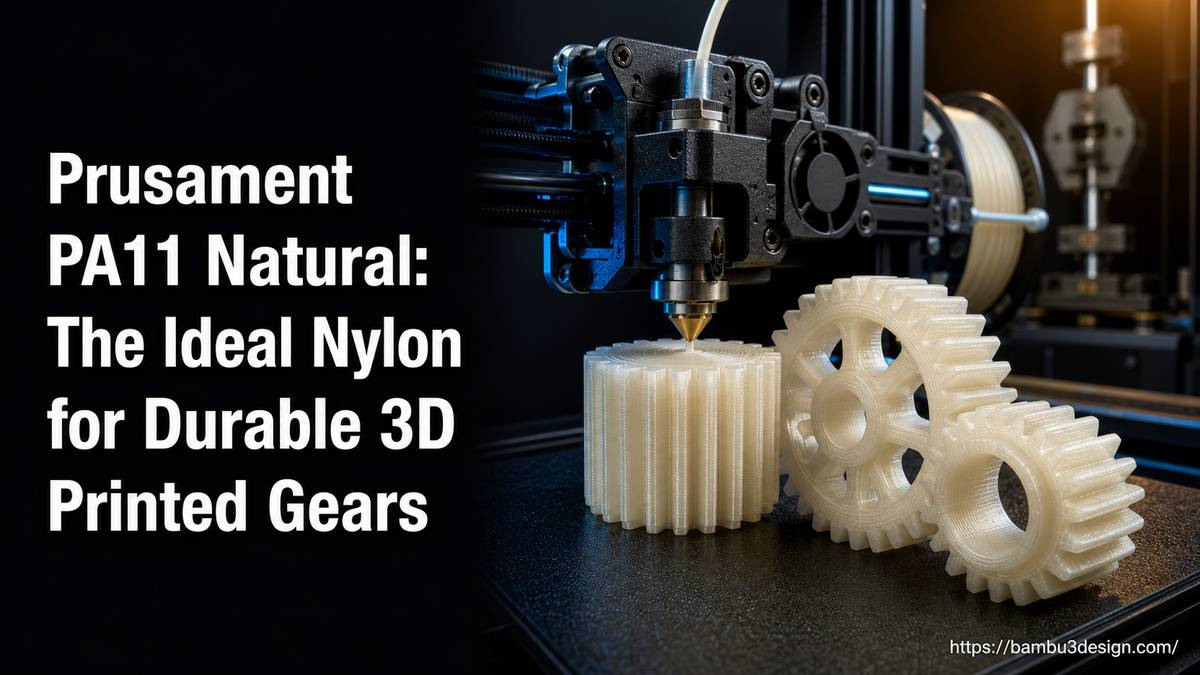
- Gears and Moving Parts: Its high wear resistance, excellent sliding properties, and isotropic strength make it ideal for printing robust, long-lasting gears, bushings, bearings, and other components in mechanical assemblies.
- Bendable Components: For parts that require a degree of flexibility and resistance to repeated bending without failure.
- Long-Lasting Outdoor Applications: Its high UV resistance makes it perfect for functional components exposed to the elements, such as connectors, mounts, or protective covers.
- Functional Prototypes and End-Use Parts: When creating prototypes that need to mimic the mechanical performance of final injection-molded parts or for producing actual end-use parts where durability and reliability are critical.
Printing Prusament PA11 Natural: Essential Considerations
To achieve optimal results with Prusament PA11 Natural, certain printing conditions are crucial:
- Enclosed Printer with Heated Chamber: Pure polyamides like PA11 are susceptible to warping due to temperature fluctuations. A fully enclosed 3D printer with a heated build chamber is essential to maintain a stable, warm environment around the print, preventing thermal stress and ensuring proper layer adhesion.
- Stable Environment, No Drafts: Even with an enclosure, drafts or sudden temperature changes can negatively impact print quality. Ensure the printing area is free from air currents.
- Proper Bed Adhesion: As with many engineering filaments, excellent bed adhesion is critical. Consult your printer’s recommendations for nylon or polyamide filaments, which often include specific build plate surfaces and adhesives.
These considerations help mitigate common challenges associated with printing nylons and unlock the full potential of Prusament PA11 Natural’s exceptional mechanical properties.
Conclusion
Prusament PA11 Natural stands out as a high-performance filament for applications demanding exceptional mechanical strength, wear resistance, and durability in various conditions. Its unique properties, particularly its superior layer adhesion, excellent sliding characteristics, and industry-leading tensile strength anisotropy, position it as the go-to material for 3D printing robust gears, reliable moving parts, and resilient outdoor components. By understanding its capabilities and adhering to proper printing techniques, makers and engineers can leverage this pure nylon filament to create truly functional and long-lasting FDM parts.